Revenue has doubled. The customer base has expanded. Production capacity has increased. Yet the promoter is spending more time solving operational problems than before.
Sales commits an urgent order. Production says capacity is already stretched. Procurement discovers that the required material was not planned. Finance is concerned about working capital. Quality raises a concern. Someone eventually takes the issue to the promoter, and the promoter steps in to resolve it.
The business is growing.
But something else is growing with it: complexity.
This is one of the less obvious consequences of growth in manufacturing: a business can become more successful commercially while becoming harder to execute operationally.
And as India’s manufacturing ecosystem expands, this question becomes increasingly important. According to the Economic Survey 2025–26, MSMEs account for 35.4% of India’s manufacturing output, 48.58% of exports and 31.1% of GDP.
For India’s large base of growing manufacturers, the challenge is therefore not simply how to grow.
It is: Can the organisation’s ability to execute grow at the same pace as the business?
Growth Doesn't Just Add Revenue. It Adds Complexity.
When a manufacturing business grows, almost everything around the revenue number changes.
A company that once served a handful of customers may now manage dozens. A product portfolio expands. Production planning becomes more complicated. Procurement involves more suppliers. Employees increase across functions. New plants or locations may be added. Sales teams make commitments that production must fulfil. Finance needs tighter control over working capital.
Every additional layer creates another dependency.
Consider a manufacturer deciding to enter a new market.
At the strategic level, the decision may look straightforward:
New market → more customers → higher production → higher revenue.
But execution creates a much longer chain:
Market entry → customer acquisition → product adaptation → costing → procurement → capacity planning → production → quality → logistics → working capital → people → technology → measurement.
The strategy may be sound.
The organisation may still not be ready to execute it.
That is where growth begins to expose weaknesses that may have remained invisible at a smaller scale.
The Operating Model That Worked at One Stage May Break at the Next
Many successful Indian manufacturing businesses are built on entrepreneurial speed.
The promoter knows the customers personally. Key employees know exactly what needs to be done. Decisions happen over a phone call. Problems are solved through experience. Experienced employees carry years of operational knowledge in their heads.
At an earlier stage, this can be a strength. The problem begins when the business becomes too large for that knowledge to remain concentrated in a few people.
The promoter cannot personally approve every important decision.
The production head cannot coordinate directly with every department.
Sales cannot rely on informal communication with production.
And employees cannot consistently execute priorities that have never been clearly defined.
Growth increases the distance between a decision being made and that decision being executed.
That distance needs systems, ownership and coordination.
Otherwise, the organisation starts depending on escalation rather than execution.
And there is an important distinction here:
If every important decision still reaches the promoter, has the business really scaled or has only its revenue scaled?
When Every Department Is Doing Its Job, But the Business Is Still Struggling
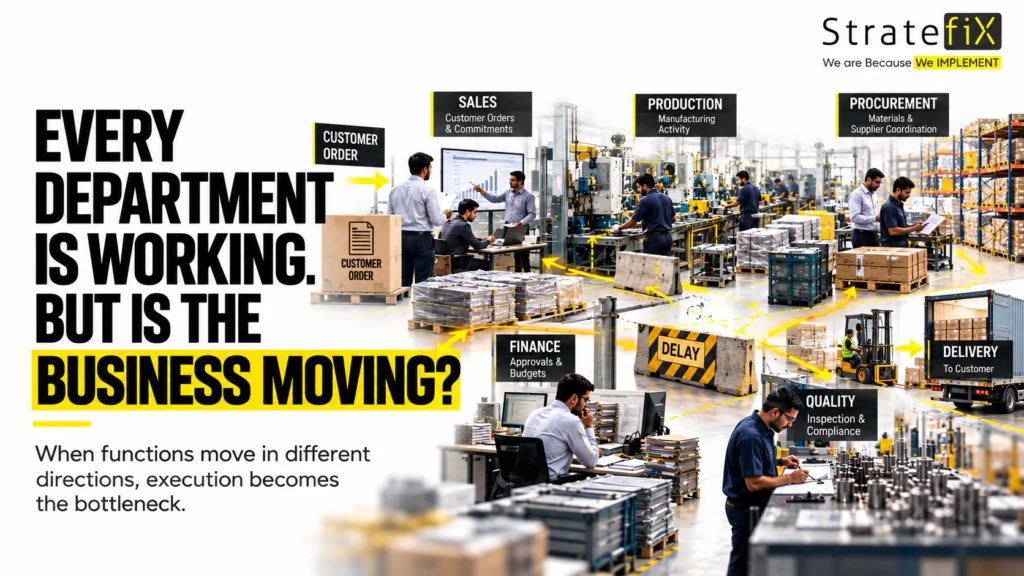
One of the most overlooked execution problems in manufacturing is that individual departments can appear to be performing well while the organisation as a whole is not.
Sales wants to maximise orders.
Production wants stable schedules.
Procurement wants efficient purchasing.
Finance wants tighter working capital.
Quality wants fewer defects.
HR wants to manage workforce requirements.
Each objective may be reasonable.
But the customer experiences only one business.
Imagine a growing manufacturer on a Monday morning.
Sales has committed a large order.
Production says the required capacity is unavailable.
Procurement discovers that some raw material was not planned.
Finance is concerned about additional inventory.
Quality has identified a specification issue.
Every department has a valid reason.
Yet the customer still expects one answer:
Will you deliver or not?
This is where growth exposes a deeper organisational issue.
The problem may not be that any department is doing its job badly.
The problem is that the departments are not necessarily executing one shared business priority.
That is not simply a departmental performance problem.
It is an execution architecture problem.
McKinsey: Having a System Is Not the Same as Implementing It
The distinction between designing a system and actually embedding it is not unique to Indian manufacturers.
In a 2026 study of more than 100 manufacturing COOs, McKinsey found that 74% said their company had a global production system, but only 29% said it was fully implemented across all sites.
The gap is revealing.
A company can have:
- an ERP system without reliable data discipline,
- SOPs without consistent adherence,
- KPIs without accountability,
- a transformation roadmap without implementation ownership,
- automation without workforce adoption.
The presence of a system is not the same as the performance of the system.
74% have a production system. Only 29% say it is fully implemented across all sites.
That gap between “we have it” and “we consistently use it” is where many transformation initiatives lose momentum.
And it highlights an important point for growing manufacturers:
Execution is not about creating more plans. It is about making the chosen way of working happen consistently.
India's Manufacturing Challenge Is Increasingly About Execution at Scale
BCG’s 2026 research on India’s auto-component sector describes a similar shift.
After a period of strong expansion and increasing global competitiveness, BCG identifies the next challenge as execution at scale, building manufacturing systems capable of delivering speed, productivity and resilience as complexity increases.
This changes the management question.
For a growing manufacturer, it is no longer enough to ask:
Can we do this?
The more important question becomes:
Can we do this consistently, across teams, across plants and at a larger scale?
Doing something once is capability.
Doing it repeatedly, reliably and profitably at scale is execution.
Technology Does Not Automatically Solve the Execution Problem
Technology is increasingly part of the answer.
ERP, automation, AI, analytics and connected manufacturing can improve visibility and decision-making.
But technology itself does not create execution discipline.
EY’s research on digital transformation for Indian manufacturing and MSMEs describes the journey as moving from strategy to pilot and scale, followed by optimisation and sustained adoption. The emphasis is not simply on selecting technology, but also on workforce upskilling, refining initiatives and embedding change into the organisation. [4]
That distinction matters.
A company can announce an ERP transformation.
It can purchase automation.
It can launch an AI initiative.
But the real questions are:
Who owns the implementation?
Which processes need to change?
How will employees adopt it?
What will management measure?
How will problems be corrected?
Installing technology is an implementation milestone.
Making it part of how the organisation works is execution.
And execution should not be confused with simply asking people to work harder.
Execution is about creating the conditions in which the right people can make the right decisions, follow the right processes and move toward the same outcome.
What Growth Looks Like on the Ground
Consider a growing textile manufacturer facing increasing order volumes.
As the business expanded, several problems began appearing together: production information was difficult to consolidate, departments operated in silos, responsibilities were unclear, SOPs were not consistently followed and the existing ERP setup was not producing the visibility management needed.
The response was not simply another strategic recommendation.
The organisation worked on several execution mechanisms: clearer accountability through RACI, standardised SOPs, KPI-based reviews, ERP optimisation, MIS reporting and workplace organisation.
The company subsequently reported a reduction in order turnaround time from roughly 60 days to 40-45 days and a 25% increase in productivity.
The interesting lesson is not the percentage improvement itself.
It is what produced the improvement.
No single initiative solved the problem.
The change came from connecting:
People + Processes + Technology + Accountability + Measurement
This is an important distinction.
The answer to a growing company’s execution problem is rarely “work harder.”
It is usually make the organisation work together better.
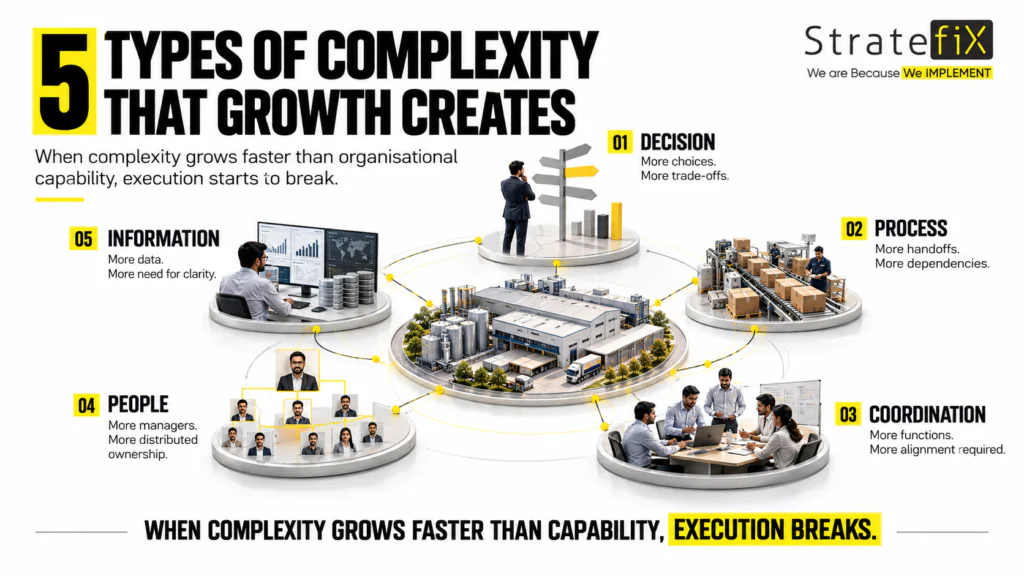
Five Types of Complexity That Growth Creates
As manufacturing businesses scale, five forms of complexity tend to increase.
- Decision complexity
There are more products, customers, markets, investments and trade-offs.
- Process complexity
Informal ways of working begin creating inconsistency, delays and dependency on individuals.
- Coordination complexity
More departments, functions and locations need to move together.
- People complexity
The organisation needs managers and functional leaders who can execute without constant promoter intervention.
- Information complexity
Management needs timely, reliable data rather than fragmented reports and individual interpretations.
The problem occurs when these complexities grow faster than the organisation’s ability to manage them.
Growth becomes an execution problem when complexity grows faster than organisational capability.
That may be the most important lesson for a manufacturer entering its next phase.
Growth Requires More Than a Strategy. It Requires an Execution Architecture.
There is no single operating model that fits every manufacturer.
But businesses entering a new phase of growth should examine five fundamentals.
Clear priorities
Everyone should understand which business outcomes matter most.
Defined ownership
Important initiatives need someone accountable for the outcome, not simply someone responsible for a task.
Cross-functional alignment
Functions need shared objectives when their decisions affect one another.
Processes and capabilities
The organisation needs the SOPs, skills, systems and governance required to perform consistently.
Measurement and correction
Execution needs regular review. When performance falls short, the organisation needs to understand why, correct it and continue.
Together, these create a continuous cycle:
Strategy → Ownership → Implementation → Execution → Measurement → Correction
And the cycle does not end when the strategy is approved. Because execution is not what happens after strategy. Execution is how strategy becomes real.
The Question Indian Manufacturers Should Ask Before Their Next Growth Phase
India’s manufacturing opportunity is significant.
But growth itself does not guarantee a stronger business.
A company can add customers without improving profitability.
It can add capacity without improving utilisation.
It can implement technology without improving decision-making.
It can create strategies without creating the organisational capability to execute them.
The more a business grows, the more important the operating system behind that growth becomes.
So before entering the next phase of expansion, leadership teams should ask a question that goes beyond:
“What should we do next?”
They should also ask:
“What will our organisation need to execute that decision successfully?”
Because sustainable growth requires more than a good strategy.
It requires an organisation capable of turning that strategy into coordinated action, measurable progress and repeatable results.
For Indian manufacturers, the next competitive advantage may not come simply from having a better growth plan.
It may come from building the capability to execute that plan at scale.