Every High-Growth Market Has a Hidden Challenge

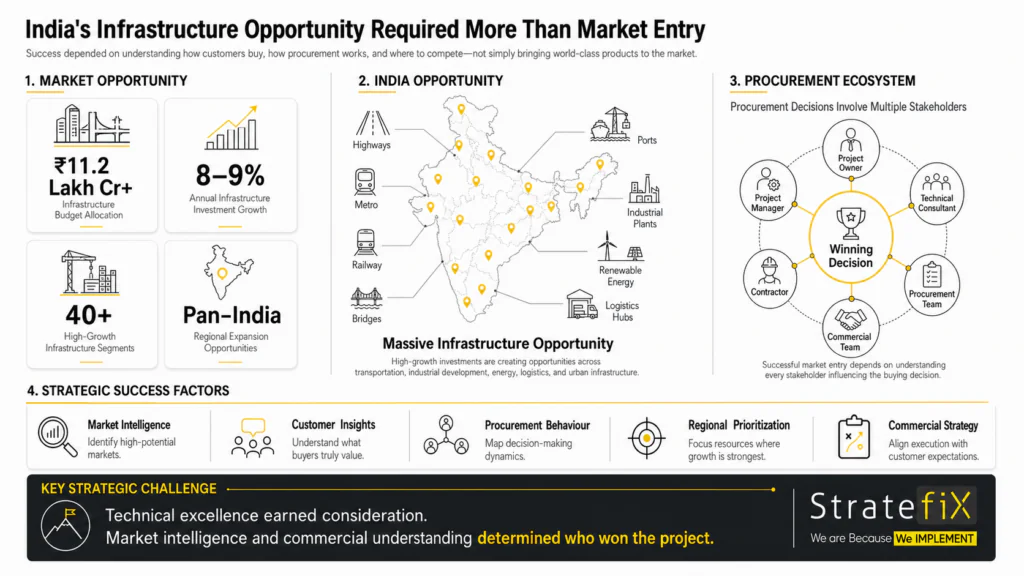
India is widely recognized as one of the fastest-growing infrastructure markets in the world. Massive investments in transportation, industrial corridors, renewable energy, urban development, and logistics continue to attract global engineering and technology companies looking to expand their footprint.

However, entering the market is only the beginning.

Winning it requires a much deeper understanding of how buying decisions are made, how procurement ecosystems operate, what customers truly value beyond product specifications, and how regional market dynamics influence commercial success.

A globally established construction solutions provider found itself at precisely this strategic crossroads.

Despite possessing internationally proven engineering capabilities and an extensive portfolio of successful infrastructure projects, the leadership team understood that replicating global success in India would require far more than introducing world-class products into a growing market.

They needed strategic clarity.

Not just where to compete, but how to win.

That challenge became the foundation of this engagement.

Growth Potential Didn't Guarantee Market Success

Why Entering India's Infrastructure Market Isn't Enough

At first glance, the opportunity appeared obvious.

Government infrastructure investments were increasing, new transportation corridors were being developed, urban infrastructure projects were expanding rapidly, and large-scale industrial development continued to create demand for advanced construction solutions. Public investment priorities reinforced the long-term attractiveness of the sector.

Yet beneath those encouraging numbers existed a far more complex reality.

India’s construction ecosystem is highly decentralized. Procurement decisions are rarely made by a single stakeholder. Technical consultants, project managers, procurement teams, contractors, developers, and commercial leaders each influence supplier selection through different evaluation criteria.

In many projects, technically superior solutions failed to convert into commercial wins.

Why?

That single question reshaped the entire consulting engagement.

Instead of assuming the answer lay in pricing or competition, Stratefix challenged a more fundamental assumption:
What if the real competitive advantage wasn't the product at all?
The Questions Leadership Couldn't Answer with Market Reports

Traditional market reports successfully estimate market size, growth rates, investment trends, and competitive landscapes.

What they rarely explain is why customers actually choose one supplier over another.

The leadership team required answers to far more strategic questions.

  • Which infrastructure segments offered sustainable long-term opportunity?
  • Which regions deserved immediate investment—and which could wait?
  • Why were technically qualified proposals losing commercially?
  • Which factors carried the greatest weight during procurement?
  • How should commercial models evolve to match changing customer expectations?
  • What capabilities would create long-term differentiation in an increasingly competitive market?

Answering these questions required more than research.

It required business diagnostics.

Looking Beyond the Data

Rather than approaching the assignment as a conventional market research project, Stratefix designed a structured consulting engagement focused on uncovering the commercial realities behind the numbers.

The objective wasn’t simply to collect information.

It was to transform fragmented market signals into strategic business intelligence that leadership could confidently use for long-term decision-making.

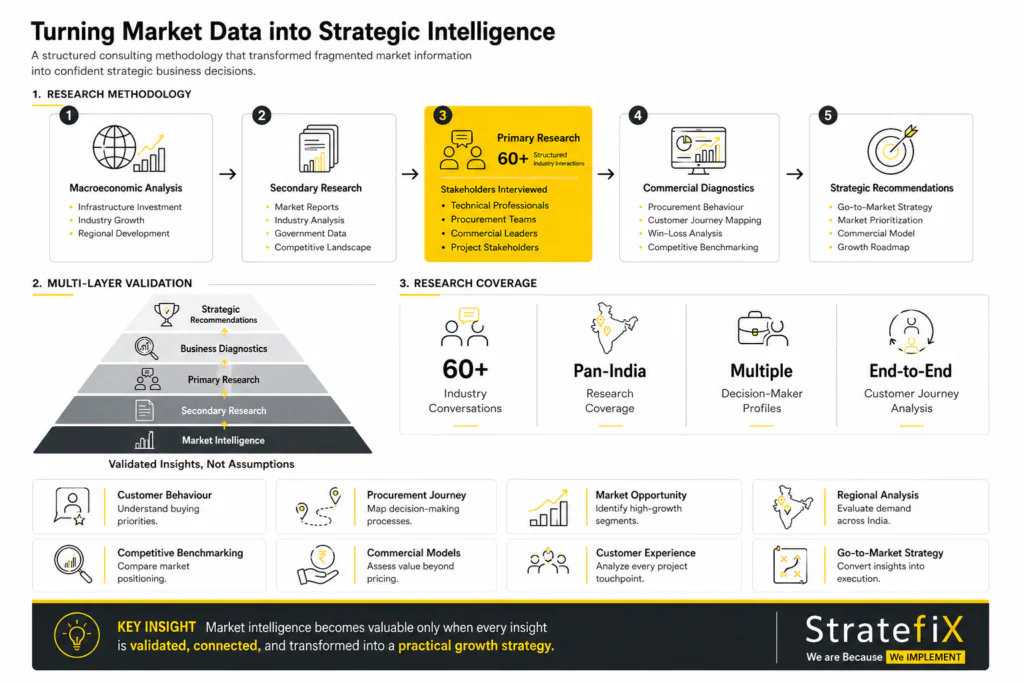
To achieve this, multiple analytical layers were integrated into a single consulting framework:

  • Macroeconomic and infrastructure intelligence
  • Secondary market research
  • Primary customer research
  • Procurement behaviour analysis
  • Customer journey mapping
  • Commercial diagnostics
  • Competitive benchmarking
  • Win-loss analysis
  • Regional opportunity assessment
  • Strategic Go-to-Market design

Instead of relying on one source of truth, every recommendation was validated through multiple perspectives before being incorporated into the final growth strategy.

Listening to the Market, Not Just Reading About It

Turning Market Data into Strategic Intelligence

One of the defining characteristics of the engagement was the emphasis placed on primary market research.

Rather than depending solely on published reports, Stratefix engaged directly with stakeholders across the construction ecosystem, including technical professionals, procurement teams, commercial decision-makers, and market participants.

These conversations revealed something that industry reports often overlook:

Customers rarely purchase engineering solutions based on technical specifications alone.

Instead, buying decisions reflected a combination of operational confidence, commercial flexibility, execution capability, service responsiveness, and long-term partnership potential.

Approximately sixty structured research interactions helped validate these behavioural patterns across multiple regions, providing a richer understanding of how purchasing decisions were actually made in the market.
The Market Was Sending a Different Message

As research findings were consolidated, several assumptions began to change. The first was perhaps the most significant.

Technical Excellence Opened Doors, Execution Capability Closed Deals

The client’s construction solutions were widely respected for their technical quality. However, technical superiority primarily determined whether the company qualified for consideration. It did not guarantee project success. Customers consistently placed equal importance on engineering responsiveness, delivery reliability, project coordination, after-sales support, and confidence in execution.

The strategic implication was profound. Future investment could not focus exclusively on product innovation. It also needed to strengthen the commercial and operational capabilities surrounding the product.

Procurement Was Evaluating More Than Price

Another important finding challenged a common misconception.

While pricing remained an important consideration, procurement teams increasingly evaluated suppliers based on overall project value rather than initial acquisition cost.

Factors such as engineering turnaround time, communication quality, local support, delivery commitment, spare parts availability, and lifecycle service significantly influenced supplier selection.

In other words…

Customers weren’t buying products. They were investing in execution certainty.

Commercial Flexibility Was Becoming a Competitive Advantage

Research also revealed a clear shift in customer expectations.

Many organizations preferred flexible engagement models that aligned with project timelines and financial constraints rather than traditional ownership structures.

Rental options, refurbishment services, project-specific commercial arrangements, and value-added support were increasingly viewed as strategic advantages rather than optional offerings.

This insight suggested that future competitiveness would depend not only on technical capability but also on commercial innovation.

One India, Many Markets

Another insight emerged when regional demand patterns were overlaid with infrastructure investment, customer feedback, and commercial opportunities.

India could not be approached as a single market.

Every region represented a distinct commercial ecosystem with its own procurement practices, infrastructure priorities, competitive intensity, and customer expectations.

Some regions were driven by transportation and mobility projects, while others showed stronger opportunities in industrial development, power infrastructure, ports, or urban expansion. Each required a different commercial approach, a different partner ecosystem, and in some cases, a different value proposition.

The implication was straightforward yet strategically significant.

A standardized national Go-to-Market strategy would dilute investment effectiveness.

Instead, market expansion needed to be prioritized based on regional opportunity, infrastructure pipeline, customer maturity, and execution readiness. This enabled leadership to focus resources where long-term growth potential was highest rather than spreading investments uniformly across the country.

The Customer Journey Didn't End with the Purchase Order

One of the most overlooked findings from the engagement was that the customer’s buying journey extended far beyond the procurement process.

For many organizations, supplier evaluation begins long before a commercial proposal is submitted and continues well after project execution.

Every interaction contributes to the customer’s perception of value.

The speed of technical responses, engineering consultation, proposal quality, logistics planning, delivery coordination, installation support, site responsiveness, refurbishment services, and after-sales engagement collectively influence whether a supplier is viewed as a long-term strategic partner or merely another vendor.

This shifted the conversation from selling products to designing customer experiences.

Organizations that consistently delivered confidence throughout the project lifecycle were significantly more likely to secure repeat business and long-term partnerships than those competing primarily on product specifications.

For the client, this meant strengthening every customer touchpoint, not just improving sales effectiveness.

Turning Insights into Action

GO-TO-MARKET STRATEGY

Research alone does not create business value. The true impact of consulting lies in translating insights into decisions that shape future growth.

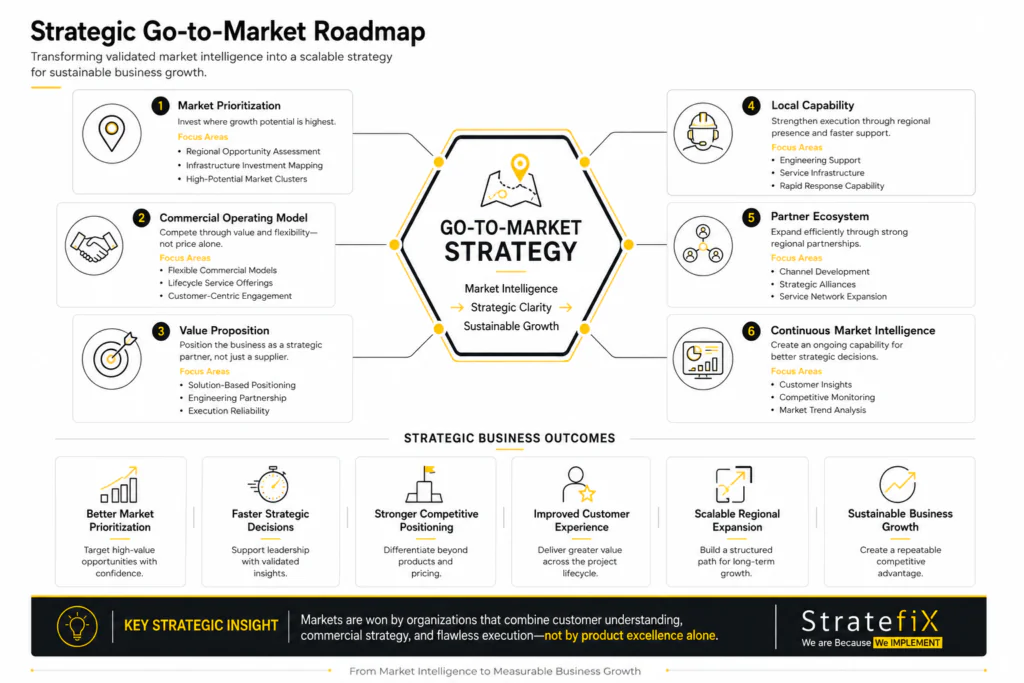
Based on the market diagnostics, Stratefix developed a comprehensive Go-to-Market roadmap that aligned market opportunities with commercial capabilities and execution priorities.

Rather than recommending isolated tactical improvements, the roadmap was structured around six strategic growth pillars.

  1. Prioritize Markets, Not Just Opportunities

Instead of expanding uniformly across India, the strategy recommended a phased market entry model focused on high-potential infrastructure clusters.

Regions were prioritized based on investment activity, infrastructure pipeline, customer concentration, competitive intensity, and long-term commercial viability.

This approach ensured that resources were deployed where the probability of sustainable growth was highest.

  1. Strengthen the Commercial Operating Model

Research indicated that customers increasingly valued commercial flexibility alongside technical capability.

The strategy recommended evaluating alternative commercial structures, including project-specific engagement models, value-added service offerings, and lifecycle-oriented commercial solutions that aligned more closely with customer expectations.

The objective was not to compete on price but to compete on value.

  1. Reposition the Value Proposition

The analysis revealed that technical excellence alone was no longer sufficient to differentiate the business.

Future market positioning needed to emphasize execution reliability, technical partnership, engineering responsiveness, local support, and lifecycle value.

This represented a shift from product-centric communication to solution-centric positioning.

  1. Invest in Local Capability

Customers consistently associated local presence with lower execution risk.

Strengthening regional engineering teams, improving service infrastructure, enhancing technical support, and accelerating delivery responsiveness were identified as critical enablers of future competitiveness.

These investments would improve customer confidence while creating stronger barriers to competition.

  1. Build a Scalable Partner Ecosystem

Sustainable expansion required more than increasing direct sales coverage.

The roadmap outlined the importance of developing a structured ecosystem of channel partners, regional collaborators, and service capabilities that could support long-term market penetration without compromising quality or customer experience.

  1. Convert Market Research into an Ongoing Capability

Perhaps the most valuable recommendation extended beyond the immediate Go-to-Market strategy.

Markets evolve continuously.

Customer expectations change.

Competitive dynamics shift.

Infrastructure priorities move from one region to another.

Rather than treating market research as a one-time exercise, the engagement recommended building a continuous market intelligence capability that would enable leadership to make informed strategic decisions as market conditions evolved.

This transformed research from a project into a strategic business capability.
Creating Strategic Clarity for Future Growth

The value of the engagement was not measured by the number of reports delivered or presentations completed.

Its real value lay in reducing strategic uncertainty.

Leadership gained a clearer understanding of where future opportunities existed, how customers evaluated suppliers, which commercial capabilities required strengthening, and how regional expansion should be prioritized.

The engagement enabled the organization to move beyond assumptions and make decisions supported by validated market intelligence.

More importantly, it provided a structured framework for balancing growth ambitions with operational readiness an essential capability in a market as dynamic and diverse as India.

The Bigger Lesson

Every expanding business eventually reaches a point where experience alone is no longer enough.

The decisions that shape the next phase of growth cannot rely solely on intuition, historical success, or market size projections. They require a deeper understanding of customer behaviour, commercial realities, competitive positioning, and execution capability.

This engagement demonstrated that successful market expansion is not determined by having the most advanced product. It is determined by how effectively an organization aligns its strategy with the realities of the market it intends to serve.

By integrating macroeconomic intelligence, primary research, customer journey analysis, commercial diagnostics, and strategic planning into a unified consulting framework, Stratefix helped transform uncertainty into direction and market complexity into actionable strategy.

Because in the end, markets are not won by the companies with the best products. They are won by the companies that understand their customers better than anyone else and execute that understanding consistently