How a Global Textile Export Company Achieved Over 43%+ Business Growth Through Strategic Execution
One of Stratefix Consulting’s longest-serving transformation engagements, demonstrating how sustained consulting and disciplined execution helped build a stronger, scalable, and globally competitive business.
Growth is often celebrated through numbers, but sustainable growth is built on something far more important stronger systems, better decisions, and disciplined execution.
This Global Textile Export Company had established itself as a trusted supplier across international markets, serving customers in the Middle East, Africa, Europe, and other global regions. Years of industry expertise, strong customer relationships, and product quality had created a stable and successful business.
However, the leadership recognized that the next stage of growth would require more than expanding sales or entering new markets. Scaling internationally demanded a stronger organization one capable of making faster decisions, executing consistently, building market credibility, and creating sustainable competitive advantage.
With this vision, the company partnered with Stratefix Consulting.
What began as a strategic consulting engagement gradually evolved into one of Stratefix Consulting’s longest-serving transformation partnerships, with the consulting approach continuously adapting as the business entered new phases of growth. Rather than focusing on isolated improvements, the objective was to build an organization capable of achieving sustainable success for years to come.
The Challenge

The business wasn’t struggling it was evolving.
Like many successful organizations, the systems and processes that had supported years of steady growth were no longer sufficient to achieve the company’s larger ambitions.
The leadership wanted to accelerate growth, strengthen profitability, and expand into new international markets. Achieving these objectives required more than operational improvements, it demanded a fundamental transformation across strategy, people, processes, and execution.
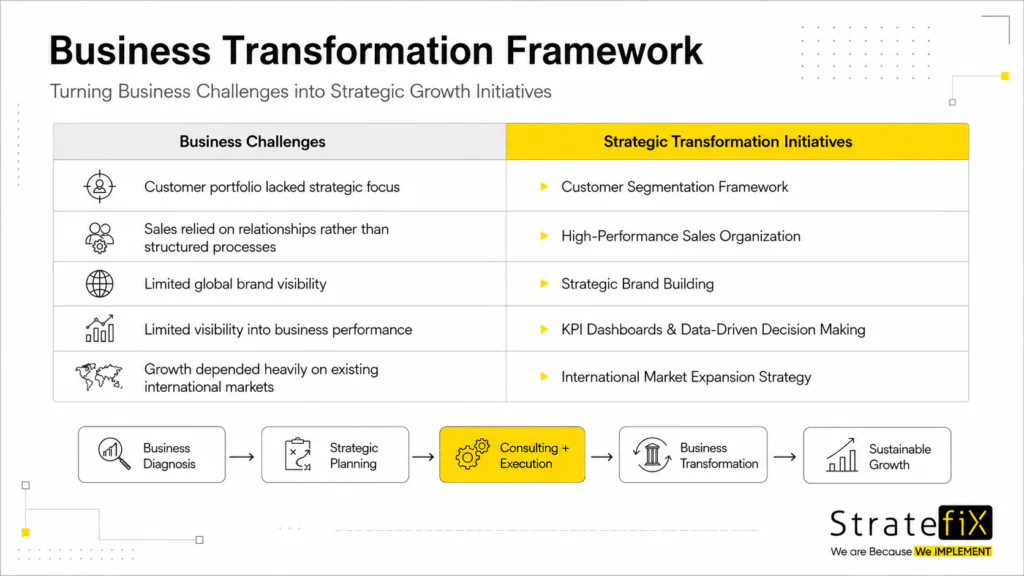
A comprehensive business diagnosis identified five critical areas that required attention.
Customer Growth Was Outpacing Customer Quality
Over the years, the company had built a diverse customer base through referrals, relationships, and consistent service. While this created stability, it also meant valuable management time and operational resources were being invested across customers with varying levels of strategic value.
To improve profitability and support long-term growth, the business needed to focus on acquiring and developing larger, high-potential customer relationships while gradually reducing its dependence on lower-value accounts.
Sales Relied More on Relationships Than Structure
Sales performance depended heavily on individual experience and customer relationships.
Although this approach had delivered success for many years, it provided limited visibility into sales performance, account management, and future business opportunities. As international operations expanded, the absence of standardized processes, structured accountability, and measurable performance made scaling increasingly difficult.
Brand Presence Didn’t Match Business Capability
Despite operating across multiple international markets, the company’s external brand presence remained relatively limited.
Industry exhibitions were not being fully leveraged as business development platforms, digital visibility was minimal, and strategic communication had not yet become part of the company’s growth strategy.
For an organization looking to enter new markets, stronger brand credibility was becoming as important as operational capability.
Business Decisions Needed Better Visibility
Leadership had successfully managed the business through years of experience and market understanding.
However, as operations became more complex, decision-making required greater visibility into business performance, customer portfolios, market opportunities, and organizational effectiveness.
The company needed systems that transformed business information into actionable insights.
Building an Organization Ready for Scale
Future growth required stronger internal capabilities.
Sales, recruitment, marketing, leadership alignment, and performance management all needed to evolve together. Rather than solving individual operational challenges, the objective became building an organization capable of supporting long-term international expansion.
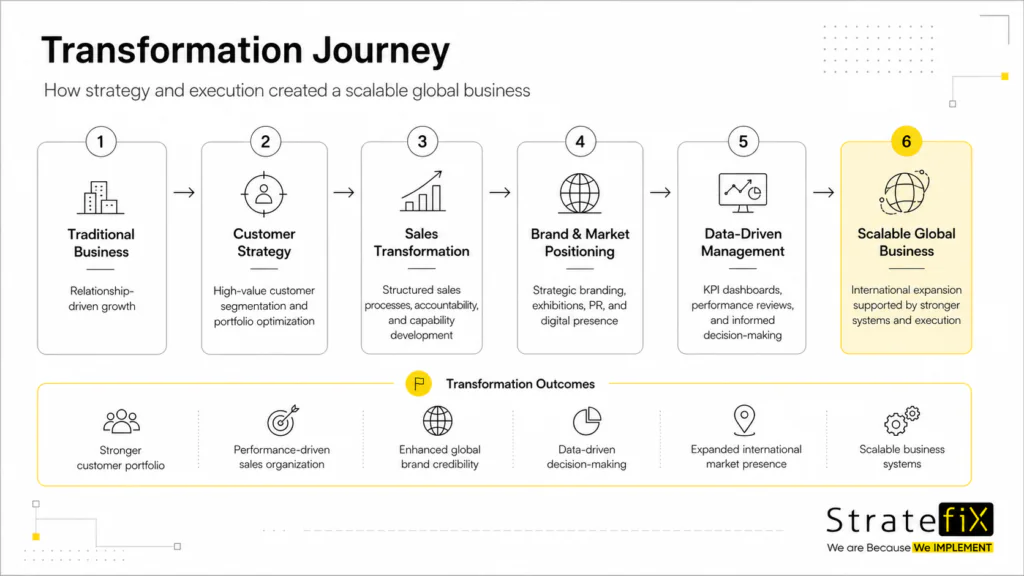
The Transformation Strategy
Business transformation rarely succeeds through isolated initiatives.
It succeeds when every critical part of the organization moves in the same direction.
Instead of delivering recommendations and stepping away, Stratefix worked alongside the leadership team through its Consulting + Execution approach, supporting implementation, reviewing progress, refining strategies, and adapting priorities as the business evolved.
Over the course of the engagement, the transformation focused on four strategic priorities:
- Optimizing the customer portfolio for profitable growth.
- Building a high-performance sales organization.
- Strengthening market visibility and brand credibility.
- Creating a data-driven operating model that improved accountability and decision-making.
Each initiative was designed not simply to improve performance, but to build long-term business capability.
Building a More Profitable Customer Portfolio
One of the first strategic priorities was redefining what sustainable growth meant for the business.
Instead of pursuing customer growth through volume alone, the company adopted a more disciplined approach centred on long-term value.
A structured customer segmentation framework was introduced to evaluate customers based on profitability, strategic importance, and future growth potential.
This enabled leadership to identify high-value customer relationships that deserved greater investment while gradually reducing dependence on accounts that delivered limited long-term value.
The shift represented far more than a portfolio clean-up.
It changed how the organization allocated resources, strengthened customer engagement, and positioned itself to attract larger international business opportunities.
The result was a healthier customer portfolio capable of supporting more profitable and sustainable growth.
Creating a High-Performance Sales Organization
As customer strategy evolved, the sales organization also needed to transform.
Future growth demanded greater structure, stronger accountability, and improved execution across every stage of the sales process.
Sales responsibilities were redesigned with clearly defined ownership, territory-level accountability, and measurable performance expectations.
To strengthen international operations, the company expanded its commercial capabilities through strategic recruitment across key markets while simultaneously strengthening support functions such as human resources, merchandising, and marketing.
A performance-linked incentive framework aligned individual success with business objectives, encouraging greater ownership and execution discipline across the team.
Capability development also became a continuous process.
Structured performance reviews helped identify skill gaps, enabling focused coaching and targeted development initiatives that strengthened overall sales effectiveness.
Over time, the organization evolved from relationship-driven selling to a structured, performance-oriented commercial model capable of supporting long-term international growth.
Strengthening Brand Presence Across Global Markets
As the company’s internal capabilities matured, leadership recognized that sustainable international growth required more than operational excellence. It required a brand that reflected the scale, professionalism, and ambition of the business.
While the company had built strong relationships within existing markets, its market presence had not kept pace with its business capabilities. Building greater visibility and credibility became a strategic priority not only to strengthen existing relationships but also to create opportunities in new geographies.
Stratefix developed a structured brand-building strategy that combined industry exhibitions, strategic public relations, and digital marketing into a unified growth initiative.
Participation in leading national and international textile exhibitions was reimagined from a branding exercise into a business development platform. Every exhibition was planned with clear objectives, customer engagement strategies, lead management processes, and post-event follow-ups, ensuring stronger commercial outcomes.
To further strengthen market credibility, the company expanded its presence through strategic media coverage in respected business publications. These initiatives helped position the organization as a trusted and progressive player within the global textile industry.
Simultaneously, a professional digital presence was established through corporate storytelling, content marketing, and social media communication that better reflected the company’s expertise, capabilities, and long-term vision.
Together, these initiatives strengthened customer confidence, improved market visibility, and supported the company’s expansion into new international markets.
Building a Data-Driven Organization
As businesses grow, complexity increases.
Managing multiple markets, larger teams, expanding customer portfolios, and new business initiatives requires far greater visibility than traditional management approaches can provide.
Recognizing this, Stratefix introduced a structured performance management framework that brought greater clarity, accountability, and alignment across the organization.
Weekly operational reviews created a consistent rhythm for monitoring sales performance, customer acquisition, collections, and key execution priorities.
Monthly leadership reviews focused on strategic business performance, enabling management to evaluate progress, identify challenges early, and make faster, more informed decisions.
Comprehensive KPI dashboards provided real-time visibility across critical business functions, allowing leadership to monitor market performance, operational efficiency, and commercial outcomes through a single performance framework.
More importantly, these systems changed the organization’s decision-making culture.
Conversations shifted from assumptions to insights.
Business discussions became increasingly focused on measurable outcomes rather than individual opinions, enabling faster execution, stronger accountability, and better alignment across departments.
The organization gradually evolved into a business where data became an essential driver of strategy and execution.
Expanding Beyond Existing Markets
With stronger internal systems and a more disciplined operating model in place, the company was well positioned to pursue its next phase of growth.
Rather than relying primarily on established markets, leadership adopted a structured market expansion strategy focused on identifying new opportunities with long-term strategic potential.
Working closely with the leadership team, Stratefix supported market research, expansion planning, and execution that enabled the company to successfully enter several new international markets. This diversified the company’s customer base while creating new sources of business growth beyond its traditional regions.
The engagement also extended beyond strengthening the existing business.
Recognizing emerging opportunities, the leadership explored the development of a new international product vertical. Through market assessment, strategic planning, leadership recruitment, and market-entry preparation, the company established the foundation for future diversification and continued expansion.
This demonstrated an important shift in the company’s journey from growing within existing markets to building entirely new engines of growth for the future.
The Results

Business outcomes should ultimately measure business transformation.
Over the course of this long-term engagement, the company achieved measurable improvements across commercial performance, organizational capability, leadership effectiveness, and market expansion.
Over 43% Business Growth
Through stronger execution, strategic market expansion, and improved commercial capability, the company achieved more than 43% business growth, establishing a stronger foundation for long-term success.
Healthier Customer Portfolio
The business shifted its focus toward higher-value customer relationships, improving customer quality, strengthening resource allocation, and supporting more profitable growth.
A High-Performance Sales Organization
Structured accountability, territory ownership, performance-linked incentives, and continuous capability development created a more disciplined and execution-focused sales culture.
Successful International Expansion
Expansion into multiple new international markets reduced dependence on existing regions while creating new opportunities for long-term business growth.
Stronger Market Position
Strategic exhibitions, public relations, and digital marketing significantly enhanced the company’s visibility, credibility, and brand positioning within global markets.
Smarter Business Decisions
Leadership adopted structured KPIs, performance dashboards, and regular business reviews that improved visibility, accelerated decision-making, and strengthened organizational accountability.
Stronger Organizational Capability
Enhanced recruitment, improved leadership alignment, and stronger cross-functional collaboration created an organization better prepared to support future growth.
The Transformation Today
Today, the company operates with a stronger customer portfolio, a performance-driven sales organization, enhanced market credibility, and a disciplined approach to business management.
What makes this transformation particularly significant is not simply the growth achieved during the engagement, but the business capabilities that were built along the way.
Instead of relying primarily on experience and relationships, the organization now operates through stronger systems, clearer accountability, data-driven decision-making, and a structured approach to execution. These capabilities have created a scalable foundation that enables the company to pursue future opportunities with greater confidence and consistency.
As one of Stratefix Consulting’s longest-serving transformation engagements, this journey reflects the value of sustained partnership over short-term consulting. Rather than delivering recommendations alone, Stratefix worked alongside the leadership team through every stage of the transformation supporting strategic decisions, driving execution, strengthening organizational capabilities, and adapting the consulting approach as the business continued to evolve.
The result is more than a successful business transformation.
It is a stronger organization better equipped to compete globally, adapt to change, and sustain long-term growth.
Because a single milestone doesn’t define meaningful transformation.
It’s defined by building a business that is prepared for every milestone that comes next.