Every Business Has a Strategy. Not Every Business Has Alignment.
Walk into almost any growing business, and you’ll find a well-defined vision.
There are annual business plans, ambitious revenue targets, expansion goals, digital transformation initiatives, leadership meetings, and performance dashboards. Teams discuss strategy, review KPIs, and invest in technology to improve efficiency.
Yet despite all this effort, many businesses continue to experience the same challenges:
- Growth slows despite increasing investment.
- Departments operate in silos.
- Leadership meetings end with agreement but little execution.
- Founders become the centre of every important decision.
- Employees complete tasks without understanding the larger purpose.
The natural conclusion is often that the strategy needs to change.
However, research and business experience suggest a different reality.
The problem is rarely the strategy itself.
The problem is alignment.
What Research Tells Us
Organizations across industries spend significant resources developing strategic plans, but execution remains one of the greatest leadership challenges.
A recent Harvard Business Review article, The False Alignment Trap, explains that leadership teams often believe they are aligned while holding fundamentally different assumptions about priorities, change, and execution. These hidden differences create friction long before implementation begins.
Another influential Harvard Business Review article, Manage Your Emotional Culture, argues that while organizations carefully manage strategy, processes, and performance, they often overlook emotional culture, even though emotions directly influence collaboration, engagement, innovation, and decision-making.
Similarly, McKinsey & Company emphasizes that sustainable organizational performance depends on alignment between leadership, culture, and organizational direction not strategy alone.
These insights point to a common conclusion.
Alignment is not just strategic. It is also operational and human.
The businesses that consistently outperform their competitors are not necessarily those with the best strategies.
They are the ones where people move together with shared purpose, trust, and commitment.
Looking Beyond Strategy
When businesses struggle to execute, leaders usually investigate visible issues:
- Are the processes broken?
- Are KPIs unclear?
- Is technology outdated?
- Are roles and responsibilities defined?
- Do we need a better strategy?
These are important questions.
But they rarely uncover the invisible forces influencing execution every single day.
Questions such as:
- Do leaders genuinely trust one another?
- Do departments solve problems together or protect their own interests?
- Do employees feel ownership or simply complete assigned tasks?
- Are difficult conversations encouraged or avoided?
- Do people believe in the company’s direction?
These are questions of emotional alignment.
And while they rarely appear on financial reports, they often determine whether strategy succeeds or fails.
The Stratefix 3A Alignment Framework
At Stratefix, we believe sustainable business growth is built on three interconnected dimensions of alignment. Growth is not created by strategy alone. It happens when ambition, actions, and attitude move in the same direction.
This perspective forms what we call the Stratefix 3A Alignment Framework.
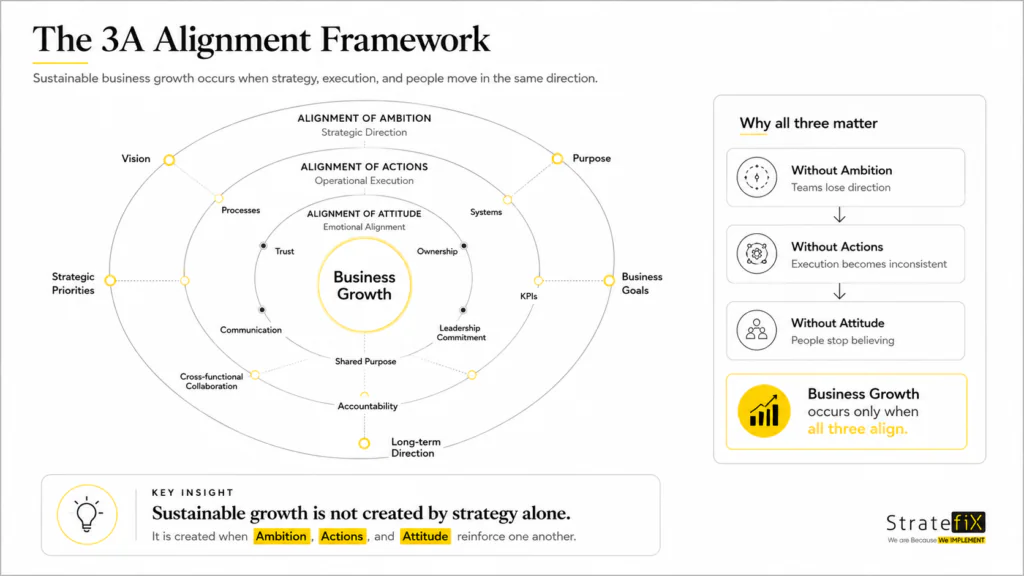
1. Alignment of Ambition
“Where are we going?”
Every business begins with ambition.
This is where leadership defines the organization’s purpose, long-term vision, strategic priorities, and growth objectives.
When ambition is aligned:
- Everyone understands the business direction.
- Leadership communicates consistent priorities.
- Teams know what success looks like.
- Decisions support long-term goals rather than short-term reactions.
When Ambition Is Misaligned
Without strategic alignment, organizations often experience:
- Conflicting priorities
- Constant changes in direction
- Department-level objectives that compete with one another
- Confusion about what matters most
- Slow strategic decision-making
A strong strategy provides clarity.
But clarity alone does not create execution.
2. Alignment of Actions
“How will we achieve it?”
Even the best strategy fails if execution lacks structure.
Alignment of Actions ensures that systems, processes, governance, KPIs, accountability, and collaboration all support the strategic direction.
This is where businesses translate ambition into measurable execution.
Organizations with strong operational alignment typically demonstrate:
- Clearly defined responsibilities
- Effective cross-functional collaboration
- Standardized processes
- Data-driven decision-making
- Consistent execution across teams
When Actions Are Misaligned
Operational misalignment often appears as:
- Departments working in isolation
- Founder dependency
- Repeated firefighting
- Delayed execution
- Conflicting KPIs
- Poor accountability
Many organizations spend years improving systems and processes.
Yet execution still falls short.
Why?
Because one important dimension remains unaddressed.
3. Alignment of Attitude
“Do people truly believe in where we’re going?”
This is the most overlooked and often the most powerful dimension of business growth.
Alignment of Attitude is what we describe as Emotional Alignment.
It is not about making emotional decisions.
Nor is it about ensuring everyone agrees all the time.
Instead, it reflects the shared emotional commitment of leaders and teams toward a common purpose.
It answers questions such as:
- Do leaders trust one another?
- Do managers take ownership?
- Can teams have honest conversations?
- Are employees committed to the organization’s success?
- Do people solve problems together rather than assign blame?
When attitude is aligned, organizations experience:
- Higher trust
- Greater ownership
- Better collaboration
- Faster decision-making
- Stronger accountability
- More resilient leadership teams
When attitude is misaligned, the symptoms become familiar:
- Internal politics
- Low trust
- Blame culture
- Resistance to change
- Leadership conflicts
- High attrition
- Weak execution
These issues often appear to be operational problems.
In reality, they are frequently signs of emotional misalignment.
Why the Three A's Matter Together
Many businesses focus on only one or two dimensions.
Some have ambitious strategies but inconsistent execution.
Others have excellent systems but teams that lack trust and ownership.
Neither approach delivers sustainable growth.
True business performance emerges when all three dimensions reinforce one another.
- Ambition provides direction.
- Actions create consistency.
- Attitude builds commitment.
When these three align, strategy is no longer just a document.
It becomes something people genuinely believe in and consistently execute.
That is where sustainable business growth begins.
The Hidden Cost of Emotional Misalignment
Financial statements rarely include a line item called “Emotional Misalignment.”
Yet its effects appear throughout the organization every single day.
It shows up in delayed decisions, leadership conflicts, declining employee engagement, customer dissatisfaction, and inconsistent execution. Over time, these challenges directly influence profitability, productivity, and business growth.
The problem is that most organizations treat these as isolated operational issues rather than recognizing the deeper pattern connecting them.
When leaders address only the symptoms, the underlying cause remains.
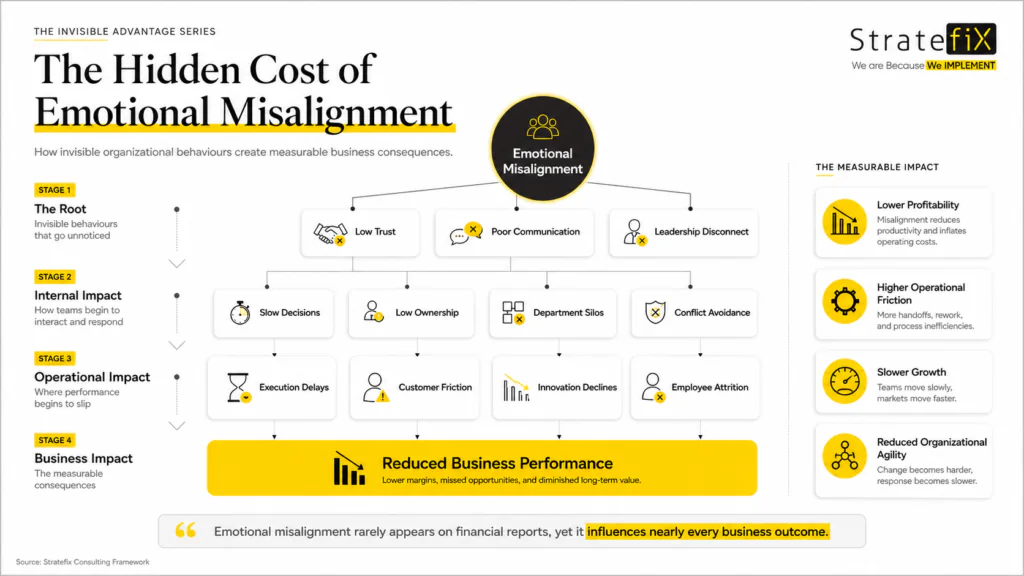
How Emotional Misalignment Affects Business Performance
Imagine a growing manufacturing company.
The business has a clear expansion strategy, experienced department heads, defined KPIs, and modern systems.
On paper, everything appears aligned.
However, over the next twelve months, several challenges emerge:
- Projects consistently miss deadlines.
- Sales promises exceed operational capacity.
- Production blames procurement.
- Procurement blames planning.
- HR struggles with increasing attrition.
- Customer complaints begin to rise.
- Every major decision ultimately reaches the founder.
None of these issues seem connected.
In reality, they often share the same root cause.
People are working for the same company, but they are no longer working toward the same purpose.
Trust begins to decline.
Ownership decreases.
Communication becomes defensive.
Departments optimise their own performance instead of the organization’s success.
Execution slows not because people lack capability, but because they lack alignment.
Emotional Misalignment Doesn't Start with Conflict
One of the biggest misconceptions is that emotional misalignment only exists when people openly disagree.
More often, it begins with silence.
Leaders stop challenging each other.
Managers avoid difficult conversations.
Employees choose compliance over commitment.
Meetings become polite.
Feedback disappears.
Problems remain hidden until they become business crises.
The absence of conflict should never be mistaken for alignment.
Healthy organizations encourage respectful disagreement because it creates better decisions and stronger commitment.
The Business Cost of Emotional Misalignment
Emotional misalignment affects nearly every aspect of organizational performance.
1. Decision-Making Becomes Slower
When trust is low, leaders hesitate.
Approvals multiply.
Meetings increase.
Simple decisions become prolonged discussions.
Opportunities are missed while competitors move faster.
2. Accountability Declines
People begin protecting themselves rather than solving problems.
Questions shift from:
“How do we fix this?”
to
“Whose responsibility is this?”
Ownership slowly disappears.
3. Collaboration Weakens
Departments optimise their own objectives instead of business outcomes.
Sales promises become disconnected from operations.
Finance challenges every investment.
HR struggles to support initiatives without leadership alignment.
Instead of collaborating, functions compete.
4. Innovation Slows
Innovation requires psychological safety.
When employees fear criticism or failure, they stop sharing ideas.
Businesses lose opportunities long before competitors introduce better solutions.
5. Customer Experience Suffers
Internal misalignment eventually becomes visible externally.
Customers experience delayed responses.
Service quality becomes inconsistent.
Commitments are missed.
Trust with clients begins to erode.
6. Profitability Declines
Few leaders connect emotional alignment with financial performance.
Yet execution delays, poor collaboration, higher attrition, customer dissatisfaction, and slow decision-making all create measurable financial consequences.
Emotional alignment is not simply a cultural concept.
It is a business performance driver.
The Founder Trap
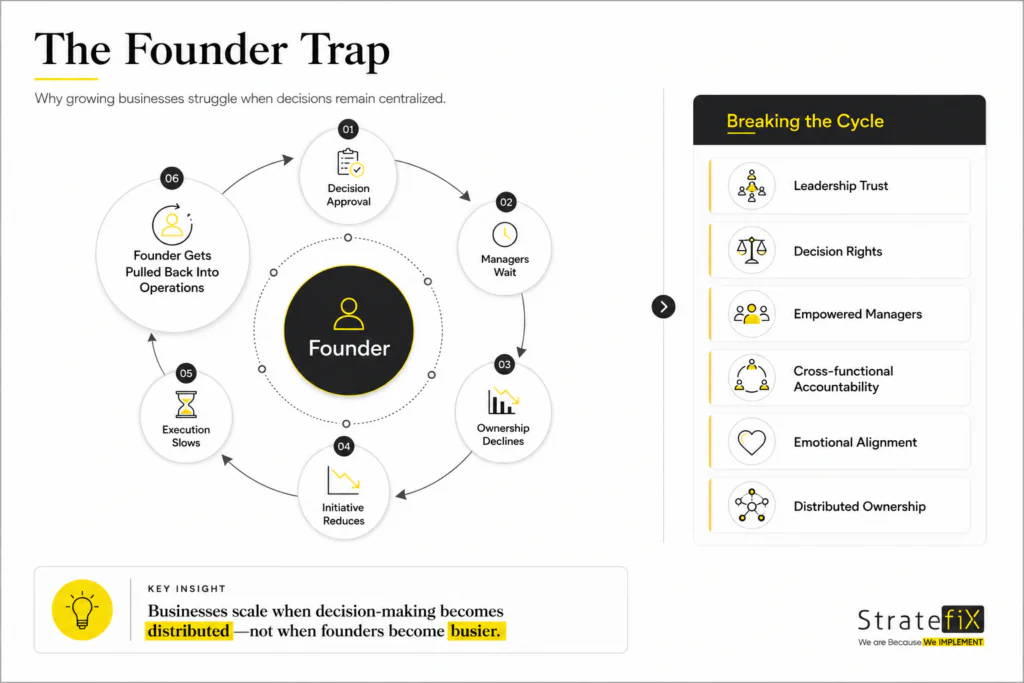
Many growing businesses unintentionally create what we call The Founder Trap.
In the early stages of growth, founder involvement accelerates decision-making.
The founder knows every customer.
Every employee.
Every challenge.
Every opportunity.
This works while the business remains relatively small.
As the organization grows, however, the same behaviour becomes a constraint.
Every important decision still reaches the founder.
Managers hesitate to act independently.
Teams wait for approval instead of taking ownership.
Eventually, growth begins depending on one person’s availability rather than the organization’s capability.
The challenge is rarely competence.
It is confidence.
When leaders and managers feel trusted, empowered, and emotionally connected to the organization’s purpose, ownership naturally expands beyond the founder.
Breaking the Founder Trap requires more than delegation.
It requires alignment.
From Compliance to Commitment
One of the clearest indicators of emotional alignment is the difference between compliance and commitment.
Compliant teams complete assigned tasks because they are expected to.
Committed teams solve problems because they believe in the outcome.
Compliance follows instructions.
Commitment creates initiative.
Compliance waits for approval.
Commitment takes ownership.
Compliance maintains the status quo.
Commitment drives continuous improvement.
The most successful organizations are built on commitment not compliance.
Building Emotional Alignment Is a Leadership Responsibility
Contrary to popular belief, emotional alignment cannot be delegated to the HR department.
Nor can it be achieved through annual engagement surveys or occasional team-building activities.
It is created through consistent leadership behaviours.
Leaders strengthen emotional alignment when they:
- Communicate the “why” behind decisions.
- Encourage constructive disagreement.
- Build trust through transparency.
- Recognise ownership instead of hierarchy.
- Create psychological safety for honest conversations.
- Demonstrate consistency between words and actions.
- Celebrate collaboration rather than individual heroics.
These behaviours gradually create a culture where people align not only with business objectives but also with one another.
Leadership Development Beyond Skills
Many leadership programmes focus on strengthening individual competencies such as communication, delegation, or decision-making.
These skills are important.
However, sustainable business growth requires something more.
It requires leaders who can create shared purpose, build trust across teams, and foster collective ownership.
This is where structured leadership development becomes valuable.
Rather than viewing leadership as an individual capability, progressive organizations increasingly treat it as an organizational capability one that influences execution, collaboration, and long-term performance.
At Stratefix, this philosophy is reflected through MANAVTM, a leadership development initiative designed to strengthen relationships, improve communication, and encourage collective ownership among leadership teams.
The objective is not simply to develop better individual leaders, but to help create an environment where people are more aligned in purpose, behaviour, and execution.
When emotional alignment improves, business execution often becomes more consistent, not because processes changed overnight, but because the people responsible for those processes began working with greater trust, clarity, and commitment.
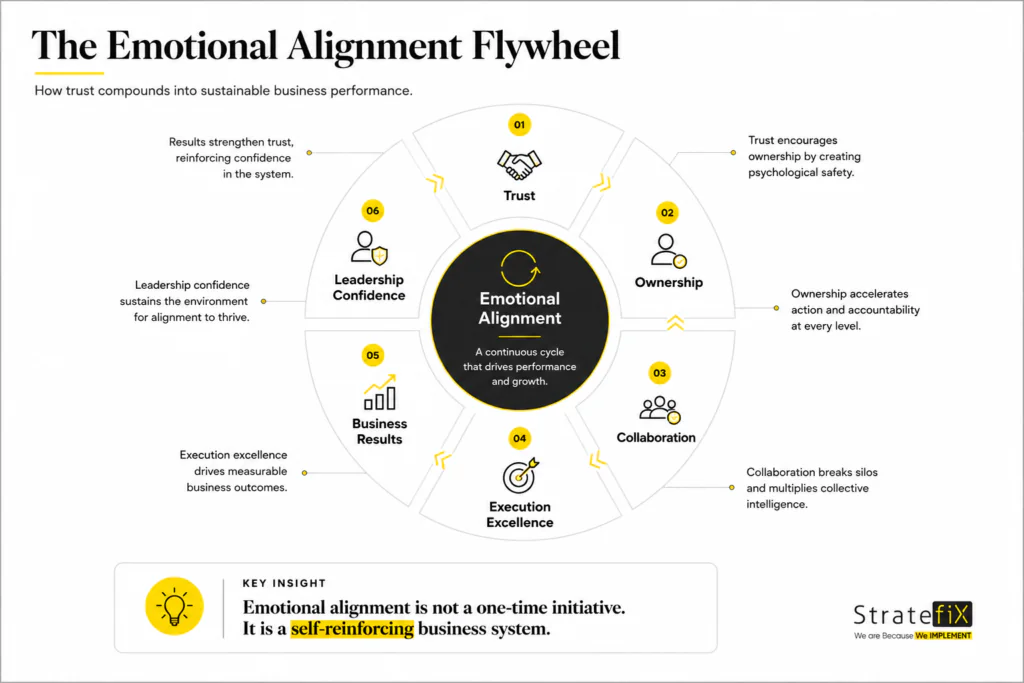
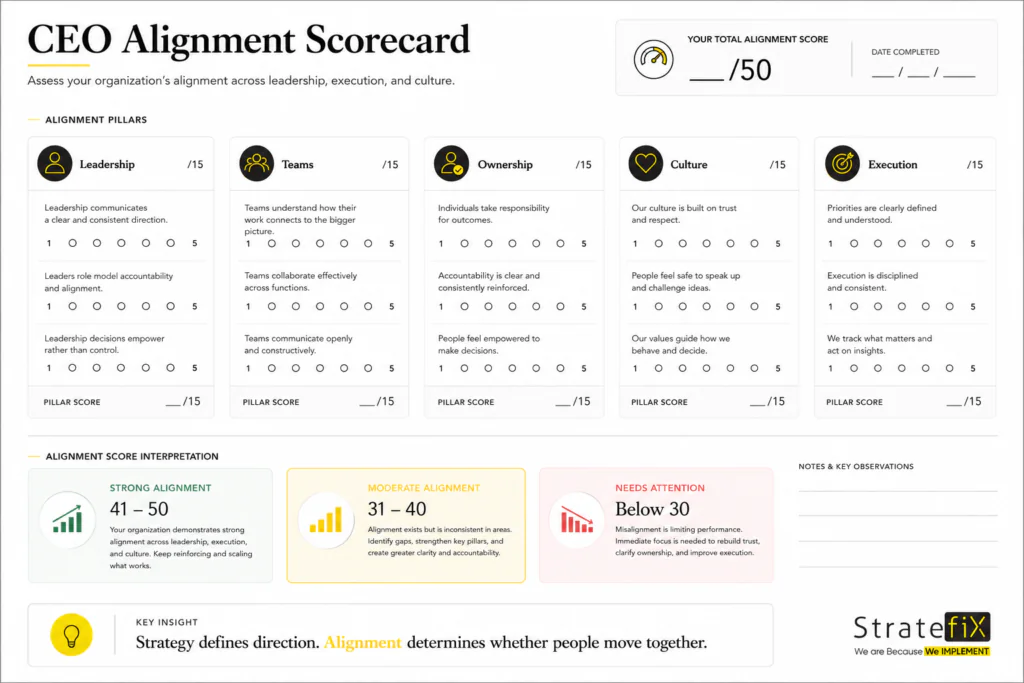
Is Your Business Emotionally Aligned?
A CEO Self-Assessment

Business leaders often assess financial performance, operational efficiency, customer satisfaction, and market growth.
But how often do they assess alignment?
Take a few minutes to reflect on the following questions.
Answer each statement honestly using the scale below:
Always | Often | Sometimes | Rarely | Never
Leadership Alignment
□ Our leadership team shares a common understanding of the company’s vision and priorities.
□ Leadership discussions result in consistent decisions rather than conflicting directions.
□ Leaders openly challenge ideas while maintaining mutual trust and respect.
Team Alignment
□ Different departments work toward common business objectives instead of departmental goals alone.
□ Teams proactively solve problems together without waiting for intervention from senior leadership.
□ Employees understand how their work contributes to the company’s larger vision.
Ownership & Accountability
□ Managers take ownership of business challenges without relying on the founder for every major decision.
□ Employees feel comfortable raising concerns, ideas, and difficult conversations.
□ Accountability is driven by commitment rather than fear.
Organizational Culture
□ Trust exists across departments and leadership levels.
□ Success is celebrated collectively rather than individually.
□ Mistakes are viewed as learning opportunities rather than occasions to assign blame.
Strategic Execution
□ Our business executes strategic initiatives consistently rather than losing momentum after planning.
□ Teams remain committed during periods of uncertainty or change.
□ Our culture supports long-term business growth rather than short-term problem-solving.
How to Interpret Your Responses
If your organization answered “Always” or “Often” to most statements, your business is likely operating with a strong level of emotional alignment.
If your responses were primarily “Sometimes,” there may be hidden gaps that could eventually affect execution, collaboration, and leadership effectiveness.
If you selected “Rarely” or “Never” multiple times, it may indicate that your business challenges extend beyond systems and processes and require deeper attention to leadership alignment, communication, trust, and organizational culture.
Emotional alignment isn’t measured by how well people get along.
It is measured by how effectively people move forward together.
Five Practical Ways to Strengthen Emotional Alignment
Building emotional alignment is not about introducing another initiative.
It is about embedding intentional leadership practices into everyday business operations.
- Communicate the “Why,” Not Just the “What”
Employees are more likely to commit when they understand the purpose behind business decisions.
Share the reasoning behind strategic priorities, not just the expected outcomes.
- Build Trust Through Consistency
Trust grows when leadership actions consistently match leadership words.
Small, consistent behaviours often influence organizational culture more than occasional motivational speeches.
- Encourage Healthy Conflict
Alignment does not require unanimous agreement.
Healthy organizations encourage respectful disagreement, explore different perspectives, and commit to a shared decision once it has been made.
Constructive conflict builds stronger execution.
Avoided conflict creates hidden resistance.
- Recognize Ownership, Not Just Achievement
Celebrate people who take responsibility, collaborate across functions, and solve business problems, not only those who achieve individual targets.
Recognition shapes culture.
Culture shapes execution.
- Invest in Leadership Alignment Continuously
Leadership alignment should not be treated as an annual event.
Regular leadership conversations, coaching, strategic reviews, and experiential development initiatives help maintain trust and strengthen collaboration as the business evolves.
Programs focused on leadership alignment, such as Stratefix’s MANAVTM initiative, can play an important role by helping leaders build stronger communication, self-awareness, and collective ownership that support long-term execution.
Final Thoughts
Businesses often believe growth depends on better strategies.
Others believe it depends on better technology.
Some invest heavily in processes, systems, and performance measurement.
All of these matter.
But sustainable growth happens when people move in the same direction with the same level of commitment.
That is why the Stratefix 3A Alignment Framework brings together three essential dimensions of business growth:
- Alignment of Ambition – A shared vision and strategic direction.
- Alignment of Actions – Systems, processes, accountability, and disciplined execution.
- Alignment of Attitude – Trust, ownership, commitment, and emotional alignment.
When even one of these dimensions is weak, growth becomes harder to sustain.
A brilliant strategy without disciplined execution remains an idea.
Efficient systems without committed people become routine.
And emotionally connected teams without strategic clarity can lose direction.
True business excellence is achieved when Ambition, Actions, and Attitude reinforce one another.
At Stratefix, we believe that sustainable growth is not built through strategy alone. It is built by aligning people, processes, and purpose so that execution becomes a natural outcome rather than a constant struggle.
Because in the end, businesses do not grow simply because they have talented people.
They grow because those talented people believe in the same destination, trust one another enough to overcome challenges, and take collective ownership of the journey.
That is the power of emotional alignment.