Every business has a strategy. Every department has a leader. Every KPI has an owner. So why does execution still fall through the cracks?
Monday morning, the leadership team asks for an update on the company’s strategic priorities.
Sales has worked on its targets. Operations has implemented some new processes. Finance has approved budgets. HR has started hiring. Marketing has launched campaigns.
Everyone is busy. Everyone can show progress.
Yet the business is still behind on the strategic outcome that mattered most.
So the obvious question is:
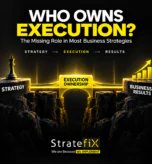
Who owns execution?
Not who owns Sales. Not who owns Operations. Not who owns a particular project.
Who owns making sure the strategy actually moves from leadership’s decision to a measurable business result?
This is one of the most overlooked questions in business strategy.
The Strategy-Execution Gap Is Real
The difficulty of turning strategy into results is well documented.
Gartner has reported that only 47% of organizations say they are fully successful at executing enterprise strategy, highlighting the challenge of translating strategic direction into executable initiatives and maintaining the mechanisms needed to keep execution moving.
PMI’s 2025 global research, involving more than 5,800 professionals and stakeholders, found that 35% of executives identified the disconnect between planning and execution as their biggest barrier to reinvention.
Earlier research associated with the Brightline Initiative also found that 59% of executives struggled to bridge strategy development and day-to-day implementation.
These findings point to an important distinction:
Having a strategy and having the ability to execute that strategy are two different capabilities.
And that leads to a more important question:
Who actually owns the execution?
Everyone Owns a Part. Nobody Owns the Whole.
Consider a company with a strategic goal to increase profitable revenue by 30%.
The Sales Head owns customer acquisition. Marketing owns lead generation. Operations owns capacity and delivery. Finance owns pricing and working capital. HR owns recruitment and capability.
All of these responsibilities are legitimate.
But the strategic outcome depends on all of them working together.
What happens when Sales needs more production capacity? When Operations needs better demand forecasts? When Finance needs to approve a pricing change? When HR cannot recruit quickly enough?
Each department can explain its position.
But who is responsible for connecting the dots?
We call this the Execution Ownership Gap.
It exists in the space between strategic intent and business outcome—the space where cross-functional decisions, dependencies, priorities, follow-ups and corrective actions have to come together.
Most organizations have functional owners.
Far fewer have someone explicitly accountable for orchestrating execution across functions.
Task Ownership Is Not Execution Ownership
This distinction is easy to miss.
Imagine a company decides to launch a new product. A project manager is assigned, a timeline is created, and tasks are distributed across Product, Procurement, Operations, Marketing and Sales.
On paper, the initiative has an owner.
But then Procurement is waiting for approval. Operations is waiting for material. Sales wants a different pricing structure. Marketing is ready to launch, but inventory isn’t available.
The project manager can report every dependency.
But reporting a problem isn’t the same as owning its resolution.
Execution ownership means making sure the organization keeps moving toward the outcome.
That requires more than task tracking. It requires connecting functions, escalating decisions, resolving dependencies, reviewing progress and knowing when the original plan needs to change.
This is why businesses can have hardworking employees, capable leaders and plenty of activity—and still struggle to execute their strategy.
The problem may not be a lack of effort.
It may be a lack of orchestration.
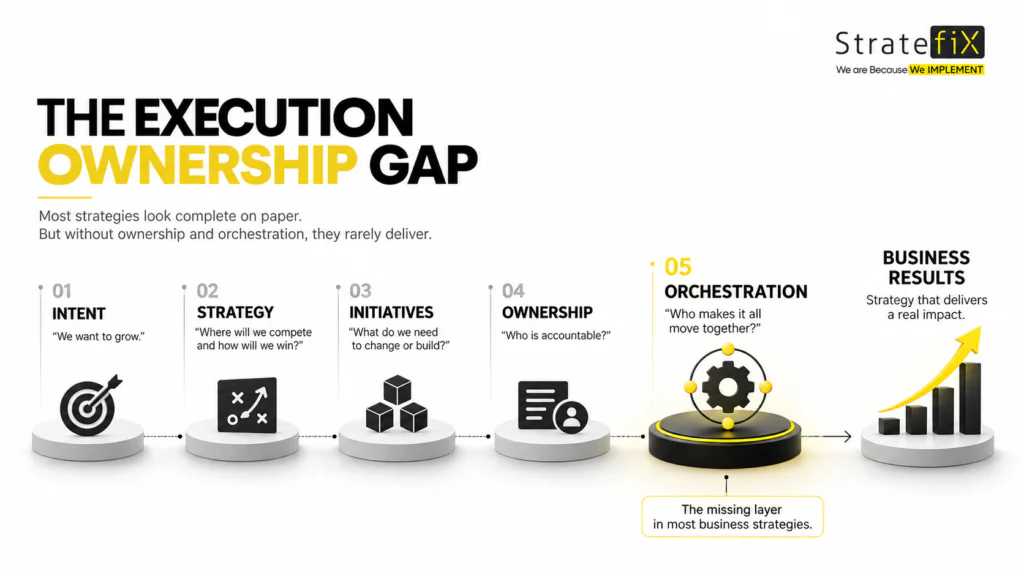
The Execution Ownership Gap
A useful way to understand the gap is to look at five levels.
- Intent: “We want to grow.” This defines ambition.
- Strategy: “This is where we will compete and how we will win.” This defines direction.
- Initiatives: “These are the things we need to change or build.” This defines action.
- Ownership: “These people are accountable for each initiative.” This defines responsibility.
- Orchestration: “Someone ensures the initiatives move together toward the strategic outcome.” This creates execution.
Most businesses are reasonably comfortable with the first four.
The fifth is where execution often breaks down.
Without orchestration, strategic initiatives become individual projects. Each team focuses on its own priorities, while the leadership team remains responsible for stitching everything together.
That may work in a small organization.
As the business grows, it becomes a bottleneck.
What Does an Execution Owner Actually Do?
An execution owner does not necessarily need to be another C-suite position. Depending on the organization, it could be the CEO, COO, transformation leader, strategy office, program team or an implementation partner.
The designation matters less than the accountability.
An effective execution owner makes five things happen.
First, strategy becomes specific. Broad ambitions are converted into measurable initiatives, owners, timelines and expected outcomes.
Second, ownership becomes visible. Every critical initiative has a person who can answer what has happened, what is blocked and what happens next.
Third, cross-functional dependencies are managed. When an initiative crosses Sales, Operations, Finance and HR, someone ensures those functions move together rather than waiting for leadership to intervene.
Fourth, progress is reviewed consistently. A strategy should not disappear until the next quarterly or annual review. Regular execution reviews create visibility and faster decisions.
Fifth, activity is connected to outcomes. Completing tasks is not enough. The question is whether revenue improved, costs reduced, productivity increased, customers were acquired or another strategic result actually moved.
This is the difference between managing activities and managing execution.
Why CEOs Often Become the Accidental Execution Owner
There is a common pattern in growing businesses.
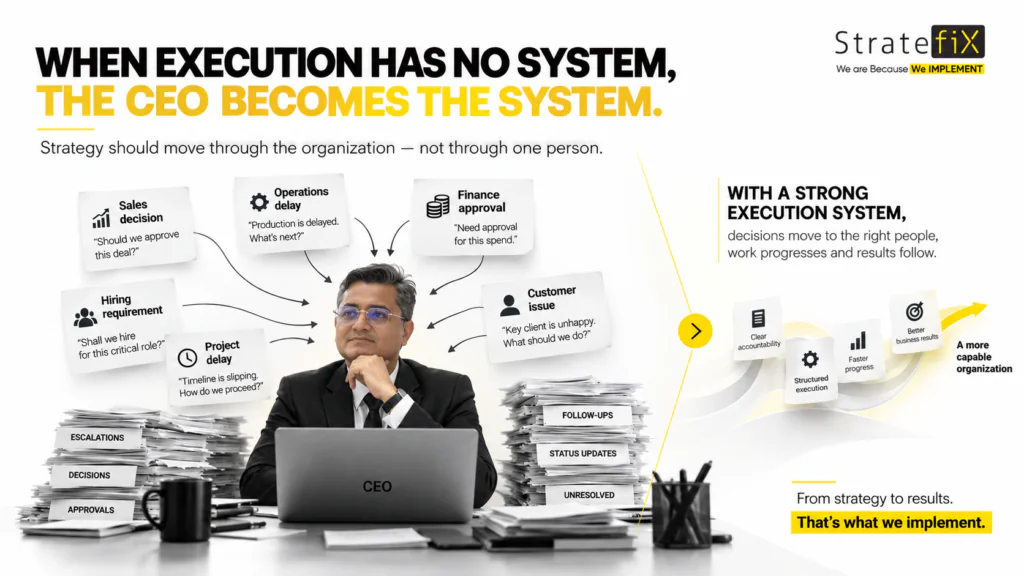
A strategic initiative gets stuck. The CEO steps in.
A cross-functional decision is pending. The CEO steps in again.
A department misses a commitment. The CEO follows up.
Another project slows down. The CEO asks for an update.
Eventually, the founder or CEO becomes the organization’s unofficial project manager.
This may work for a while. But as the business grows, it becomes a bottleneck.
Leadership should be spending more time making important strategic decisions—not chasing every unresolved action created by those decisions.
A scalable organization therefore needs distributed accountability with centralized visibility.
People should own their responsibilities, while leadership should have a clear mechanism to see whether the overall strategy is moving.
What Execution Looks Like in the Real World
Execution becomes different from simply recommending a strategy when it enters the day-to-day reality of a business.
In Stratefix’s work with a global textile export business, the focus extended beyond strategic recommendations into implementation, progress reviews, refinement and adaptation. The business reported more than 43% growth, alongside improvements in its sales structure and customer portfolio.
In another business transformation, Stratefix helped establish clearer roles, structured workflows, progress tracking, sales targets and defined responsibilities. The company reported a 15% reduction in production lead time, 47% growth in new client acquisition and a 25% reduction in wasted materials and rework.
The important lesson isn’t that these businesses used identical solutions. It is that execution improved when strategy, ownership, processes, measurement and follow-through were connected.
That connection is what many strategy documents are missing.
Before Your Next Strategy Review, Ask These Questions
Instead of asking only, “Are we on track?”, leadership teams should ask:
Who owns the overall execution of this strategy?
Which five to ten initiatives will make the biggest difference?
Who is personally accountable for each one?
What dependencies exist between departments?
What decisions are currently blocking progress?
How frequently are we reviewing strategic execution?
Are we measuring activities—or actual business outcomes?
Does every owner have the authority and resources required to deliver?
If these questions cannot be answered clearly, the organization may not have an execution problem yet.
It may have an execution ownership problem.
Strategy Needs an Owner. So Does Execution.
A strategy tells the organization where it needs to go.
Functional leaders determine what their teams need to contribute.
But between those two points lies a complicated journey of decisions, dependencies, priorities, processes and follow-through.
That journey does not manage itself.
Someone or some clearly designed system has to own it.
At Stratefix, this is the thinking behind our Consulting + Execution approach. Strategy is not treated as the final deliverable. The focus extends into implementation, accountability, measurement and continuous improvement so that strategic decisions can translate into meaningful changes within the business.
Because a strategy’s real value isn’t determined by how impressive the strategy document looks.
It is determined by what changes in the business after the strategy is approved.
So ask yourself one question:
If your strategy has an owner, but your execution doesn’t, who is actually responsible for the result?