“Let’s keep a meeting tomorrow.”
Almost every business says this daily. But the real question is, “What happens after the meeting ends?”
Do people leave with clarity?
Are decisions actually made?
Does execution become faster?
Or does the same topic quietly return next week?
For many businesses, meetings happen constantly, yet teams still feel stuck between discussions, follow ups and approvals. Not because people lack capability, but because meetings often happen without proper structure.
Research shows that meeting overload has become one of the biggest workplace bottlenecks. Nearly 78% of professionals struggle to complete actual work because of excessive meetings, while employees spend almost 10 full workweeks every year attending them. Even more concerning, 54% of employees leave meetings without clarity around next steps or ownership.
As businesses grow, communication naturally becomes more complex. More people get involved, departments become interconnected and even simple decisions require alignment. That’s why meetings become important, not as a routine activity, but as a system that keeps the business moving in the same direction.
Because when meetings are handled well, they don’t just improve communication.
They improve execution.
Why Meetings Start Feeling Exhausting
Every founder has experienced this.
A meeting begins with one important issue. Fifteen minutes later, the discussion shifts somewhere else. Someone brings up an old problem, another person explains background details and suddenly the meeting becomes longer than expected without reaching a conclusion.
The strange part is that everyone participated.
Everyone stayed busy.
Yet nothing actually moved forward.
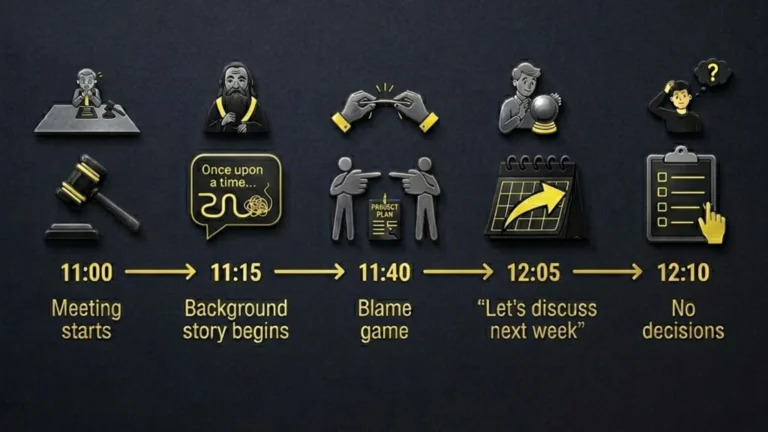
This is where businesses quietly lose productivity, not because teams are not working hard, but because conversations are not converting into decisions.
Over time, small communication gaps become operational problems:
- Teams wait for approvals
- Discussions keep repeating
- Tasks become unclear
- Follow ups increase
- Founders get pulled into everything
Meeting fatigue has become extremely common. Studies now show executives spend nearly 23 hours every week in meetings, while 76% of professionals feel mentally drained on meeting heavy days.
The issue is not meetings themselves.
The issue is meetings without structure, ownership or direction.
The Meeting Habits Businesses Often Ignore
Many meeting challenges don’t come from major mistakes.
They come from small habits that slowly become normal.
For example, many teams believe long meetings mean detailed discussions. But most of the time, long meetings simply mean the conversation lacks direction.
Without an agenda, discussions naturally expand. One topic leads to another, priorities keep shifting and eventually the original purpose of the meeting gets lost.
Research shows that 62% of employees attend meetings where the objective is unclear beforehand. At the same time, 79% of professionals believe meetings become significantly more productive when a proper agenda is shared in advance.
Another common habit is inviting everyone into every meeting. While this may feel safe, too many participants often reduce clarity instead of improving it. Discussions slow down, accountability becomes shared and decision making takes longer.
Then comes the classic line:
“Agenda ki kya zaroorat? Discussion toh ho hi jayega.”
But this habit changes the entire energy of a meeting.
Without structure, meetings become reactive. Teams discuss whatever feels urgent at that moment instead of focusing on outcomes. Important topics remain incomplete while smaller distractions consume most of the time.
Documentation also gets ignored in many businesses.
Someone says:
“Team ko samajh aa gaya hoga.”
But after two days, deadlines become unclear, responsibilities get mixed up and everyone remembers the discussion differently.
That’s why clarity matters more than conversation.
Meetings Should Reduce Confusion, Not Create More
A good meeting doesn’t need to feel overly corporate or complicated.
In fact, the best meetings are simple, focused and easy to follow.
The goal is not to discuss everything.
The goal is to move things forward.
One of the easiest ways to improve meetings is by fixing the agenda before discussions begin. Even a simple 3 Point structure changes the quality of conversations because people already know:
- what needs discussion
- what requires decisions
- what outcomes are expected
This reduces unnecessary diversions and keeps meetings aligned.
Another important improvement is respecting time. Meetings that start on time naturally become sharper because teams prepare better and discussions stay focused. When meetings stretch endlessly, attention drops and important decisions lose momentum.
Another underrated shift is this:
Talk in data, not assumptions.
Instead of saying:
“I think operations are slowing down.”
A better discussion sounds like:
“Production dropped 12% this week due to dispatch delays.”
Suddenly the conversation becomes clearer and solution focused.
Harvard Business Review studies consistently show that nearly 71% of senior managers consider most meetings unproductive and inefficient. The problem is rarely communication itself. It’s the lack of structure around it.
A Real Situation Many Businesses Relate To
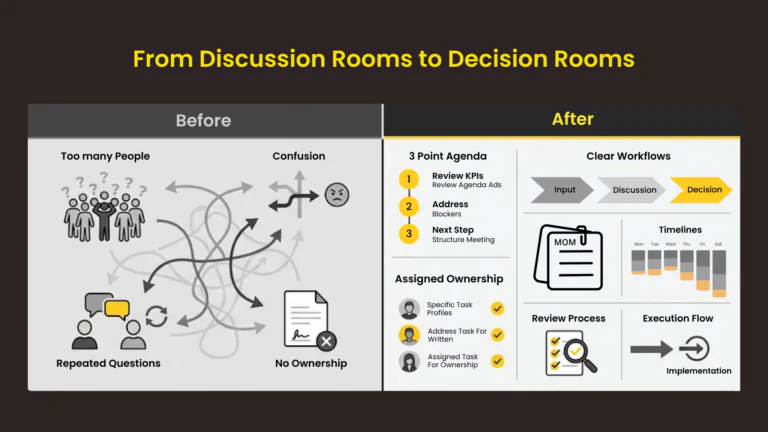
Recently, while working with a family owned textile business, our team at Stratefix noticed something interesting during review meetings. Everyone actively participated, multiple ideas were shared and leadership remained involved, yet important decisions still kept getting delayed.
Meetings included too many people, discussions moved between unrelated topics and responsibilities remained unclear after the meeting ended. Sometimes the same operational issue would return the following week because there was no proper follow through process.
The issue was never lack of effort.
The team was highly involved.
What was missing was clarity around communication, ownership and execution flow.
To simplify the process, Stratefix helped the team introduce a more structured meeting system. Different meetings were defined for different purposes like daily operational discussions, weekly review meetings and issue resolution meetings. A fixed 3 Point agenda structure was introduced, while action owners and deadlines were clearly assigned before every meeting ended.
The team also implemented a simple MOM process where meeting notes, responsibilities and timelines were shared immediately after discussions. Review timelines were defined to track progress and unresolved issues were escalated systematically instead of repeatedly circulating in discussions.
Over time, meetings became shorter, decisions became clearer and teams spent less time discussing the same problems repeatedly.
Most importantly, execution became faster because everyone understood what needed to happen next.
Small Changes That Improve Meetings
Most businesses don’t need complicated frameworks to improve meetings.
A few consistent habits create major impact over time.
1. Keep a Clear 3 Point Agenda
Too many discussion points create confusion. Focusing on 3 priorities keeps meetings productive and easier to manage.
2. Define Ownership Clearly
Every discussion should end with:
- who will handle it
- what needs to happen
- when it should be completed
Without ownership, meetings stay theoretical.
3. Share MOMs Quickly
A short MOM (Minutes of Meeting) after discussions creates clarity around decisions, deadlines and responsibilities while reducing repeated follow ups.
4. Create Different Meetings for Different Goals
Daily stand ups, weekly reviews and strategy meetings should all serve different purposes. This creates smoother communication flow across the business.
The Real Value of Well Structured Meetings
Many founders see meetings as unavoidable.
But well managed meetings become a strength for the business.
They improve:
- Communication Clarity
- Execution Speed
- Accountability
- Team Alignment
- Decision Making
More importantly, they reduce unnecessary dependency on the founder because teams begin operating with better direction and ownership.
Meetings stop feeling like interruptions.
They start becoming execution tools.
The quality of internal communication shapes the quality of execution. When meetings are unclear, teams leave with assumptions. But when meetings are structured properly, people leave with direction.
That difference matters.
Because businesses rarely slow down due to lack of effort. Most slowdowns happen because clarity gets lost between conversations, follow ups and decisions.
Well run meetings solve that gap.
And sometimes, one clear meeting can save days of confusion later.
At Stratefix, we believe strong businesses are built through clear systems, aligned teams and consistent execution and sometimes, that transformation begins with something as simple as a better meeting.