Have you ever looked at a deal in your pipeline and thought,
“This one is definitely going to close.”
The meetings went well. The prospect seemed interested. Your sales team spent weeks nurturing the opportunity. A proposal was shared, discussions happened and everyone felt positive about the outcome.
Then nothing happened.
No clear rejection. No approval. No response.
Just silence.
When this happens, the immediate reaction is usually the same.
Maybe our pricing was too high.
Maybe the competitor offered a better deal.
Maybe we simply need more leads at the top of the funnel.
While these factors can influence outcomes, they are rarely the real reason high ticket deals are lost. In reality, most large opportunities slip away much earlier in the process long before pricing becomes the main discussion.
The reason is simple.
High ticket sales do not work the same way as routine sales.
When someone buys a low value product or service, the decision is often quick and straightforward. But when a company considers a significant investment, the process becomes far more complex. Multiple stakeholders become involved, risks are carefully evaluated, budgets are scrutinized and every decision is expected to deliver measurable business value.
According to studies, the average B2B buying group now involves between 6 – 10 decision makers, while 77% of B2B buyers describe their buying journey as difficult or complex.
That means your sales team is no longer selling to one person.
They are helping an entire group reach a decision together.
And that is exactly where many businesses struggle.
The issue is not that sales teams are not working hard enough. The issue is that many organizations continue to manage high ticket opportunities using a process designed for smaller, routine transactions.
At Stratefix, we’ve observed that businesses winning larger deals are not always the ones with the biggest sales teams. They’re the ones with sales processes built around how people actually make decisions.
Mistake #1: Assuming One Champion Is Enough
One of the biggest assumptions sales teams make is believing that one enthusiastic contact means the deal is progressing smoothly. The prospect is responsive. Meetings are productive. Everyone leaves the room feeling optimistic.
Then the proposal reaches the rest of the organization.
Finance wants justification. Operations worries about execution. Leadership questions priorities.
Suddenly, the team realizes they were never selling to the full decision making group in the first place.
High ticket decisions are rarely made by one individual.
Within every buying group, priorities differ. Finance focuses on return on investment. Operations evaluates implementation risks. Leadership considers strategic alignment. End users care about practicality and adoption.
Founders should encourage their teams to identify key decision makers early, understand what matters to each of them and align the conversation accordingly.
The strongest sales teams don’t stop at finding a champion. They work to build alignment across everyone involved in the decision.
Mistake #2: Features Don't Close Large Deals. Outcomes Do.
Many sales presentations sound impressive. Features are explained, capabilities are demonstrated and technical details are discussed in depth.
Yet the prospect still hesitates.
Why?
Because buyers rarely invest significant amounts of money because of features alone.
They invest because they believe the outcome is worth it.
A business may not care that your software automates reporting. What they care about is whether it saves hundreds of hours, improves decision-making, reduces operational costs or accelerates growth.
Research consistently shows that business leaders prioritize measurable business impact over product functionality when evaluating major investments.
The strongest sales teams quantify problems, demonstrate impact and show buyers what changes because of the investment.
Most importantly, they help buyers understand the cost of doing nothing.
Features start conversations. Outcomes move decisions.
Mistake #3: Buyers Don't Approve Quotes. They Approve Business Cases.
Many businesses spend weeks nurturing an opportunity only to send a proposal focused mainly on pricing, deliverables and timelines.
Unfortunately, high-ticket buyers are not looking for quotations.
They’re looking for justification.
Before approving a significant investment, decision makers need confidence that the opportunity is worth pursuing. They need clarity around the problem being solved, the expected outcomes, the implementation approach, potential risks and the return they can expect.
Without this context, price becomes the easiest thing to compare.
And when price becomes the conversation, discounting usually follows.
Think about the proposals your team sends today. Are they helping buyers understand what they’ll receive, or are they helping them justify why this investment deserves a “yes”?
The best proposals don’t just explain the work. They help decision-makers justify saying yes.

Mistake #4: Treating Objections Like Resistance
Many salespeople view objections as barriers they need to overcome. The strongest salespeople see them as opportunities to understand what is holding the buyer back.
When prospects ask for more time, they may still be uncertain about the decision. When price becomes a concern, the real question is often whether the perceived value justifies the investment. And when additional approvals are required, it can indicate that internal alignment is still missing.
The goal isn’t to respond to objections more quickly. It’s to uncover the concern beneath them and address it with clarity.
Research highlights the growing impact of buyer uncertainty on decision-making. As uncertainty increases, purchasing cycles become longer and decision quality decreases.
Instead of teaching teams to overcome objections, founders should teach them to understand what those objections are trying to reveal.
Every objection points to a question that hasn’t been answered yet.
The sooner that question is uncovered, the easier it becomes to move the decision forward.
Mistake #5: Following Up Isn't the Same as Moving Forward
Many large opportunities don’t end with rejection, they simply fade away.
A proposal is sent.
A follow up email goes out.
Another reminder follows.
Then the conversation slowly disappears.
The problem isn’t the follow up.
The problem is the lack of value within it.
According to studies, 75% of B2B buyers prefer a rep-free experience during at least part of their buying journey.
Buyers don’t want more reminders. They want information that helps them decide.
The best sales teams understand this. Their follow ups include relevant case studies, industry insights, implementation ideas, market trends and perspectives that genuinely help buyers evaluate their options.
Following up creates activity. Adding value creates momentum.
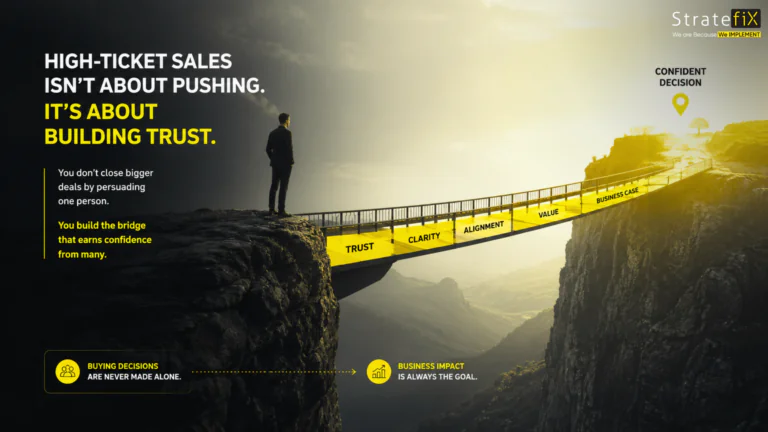
The Three Questions Every Buyer Needs Answered
After working with growing businesses, one pattern becomes impossible to ignore.
High-ticket deals are rarely won through persuasion alone. They are won through trust.
Before buyers approve a significant investment, they’re quietly trying to answer three questions.
Trust the Solution
Will this solve our problem?
Trust the Company
Can this team deliver what they promise?
Trust the Decision
Is this the right move for our business?
Most sales teams focus heavily on the first trust and spend some time building the second.
Very few actively work on the third.
Yet that third layer often determines whether a deal moves forward or quietly disappears.
Before Asking for More Sales, Ask Better Questions
When large opportunities repeatedly fail to close, the answer isn’t always more leads, more calls or more meetings.
Sometimes, it’s a better process.
Before asking your team to increase activity, ask:
- Do we understand everyone involved in the decision?
- Can we clearly quantify the customer’s business problem?
- Does every proposal build a strong business case?
- Are objections being investigated or simply answered?
- Does every follow up add genuine value?
The answers to these questions often reveal more about future growth than another sales report ever could.
A busy pipeline can create the illusion of progress.
But activity without the right process rarely translates into predictable revenue.
Final Thought
Most businesses don’t lose high ticket deals because their salespeople aren’t working hard enough.
They lose them because the sales process was built for transactions rather than decisions.
At Stratefix, we’ve seen that sustainable growth doesn’t come from pushing harder for the close. It comes from building systems that make buying easier, clearer and less risky for the customer.
Because bigger deals aren’t won by better pitches.
They’re won by making bigger decisions feel safer.
So perhaps the real question isn’t:
“How do we sell more?”
The better question is:
“How do we help our customers decide better?”
Because in high-ticket sales, the team that helps buyers make confident decisions is usually the team that wins.