Which department is the most important in your organization?
Sales? Marketing? Production? Finance? HR?
Most business leaders answer this question quickly. Revenue generating functions usually top the list, while HR is often viewed as a support function that exists to hire people, process payroll, manage attendance and organize employee events.
Now consider a different question:
When productivity drops, culture weakens, attrition rises, managers struggle and employees disengage, who gets questioned first?
In many organizations, the answer is HR.
The challenge becomes even more significant when we consider that people related issues are increasingly influencing business outcomes. According to research, only 21% of employees globally are engaged at work. According to some reports, while 93% of employees consider workplace culture important, only 36% believe their organization’s culture is clearly defined. In other words, employees care deeply about culture, but many are still unclear about what their organization’s culture actually stands for. Businesses are growing faster than ever, but people systems are often struggling to keep pace.
The result is a harsh reality: HR is expected to own people outcomes without always having the authority to influence people decisions.
That is the identity crisis of HR.
Why SMEs Feel This Challenge More
In the early stages of a business, people challenges are often easier to manage. Teams are smaller, communication happens quickly and founders remain closely connected to daily operations. Problems are identified early, decisions are made informally and employees have direct access to leadership.
Growth changes that equation.
As organizations expand, management layers increase, departments become more specialized and communication becomes more complex. Employee experiences begin to vary depending on managers, teams and departments. Decisions become distributed across the organization and maintaining consistency becomes increasingly difficult.
This is where many businesses unknowingly begin placing greater expectations on HR.
The assumption is understandable. HR manages recruitment, employee relations, policies and performance systems. Therefore, when people challenges emerge, HR naturally becomes the first point of attention.
However, reality is more complex.
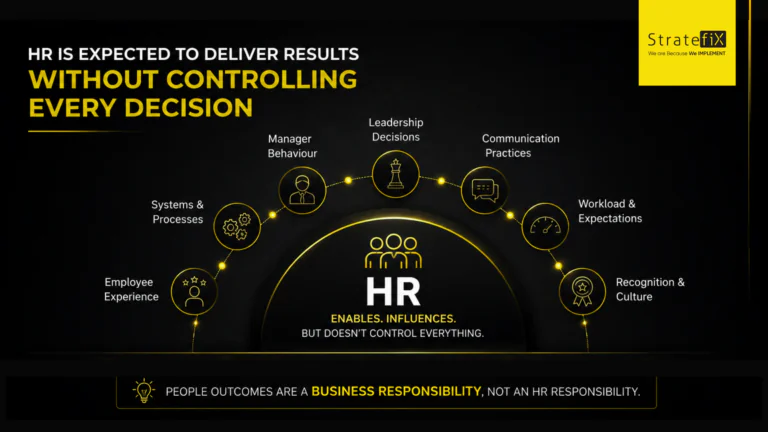
Employee experiences are shaped every day by managers, leadership decisions, communication practices, workload expectations, recognition systems and workplace culture. HR can influence these areas, but rarely controls them entirely.
The result is an environment where HR is held accountable for outcomes that are heavily influenced by decisions made across the business.
The Hidden Cost of This Assumption
One of the biggest challenges with this approach is that it often prevents organizations from identifying the true source of people related problems.
When attrition increases, businesses frequently focus on recruitment and retention initiatives. When engagement declines, new employee engagement activities are introduced. When culture feels inconsistent, organizations launch culture building programs.
While these efforts can be valuable, they often address the symptoms rather than the cause.
Research suggests that managers influence nearly 70% of employee engagement outcomes and also found that one in two employees has left a job at some point simply to get away from a manager. These findings highlight an important reality. Employee engagement, retention and workplace satisfaction are influenced significantly by leadership and managerial behavior.
Yet when these outcomes decline, HR is often expected to solve them alone.
Over time, this creates frustration across the organization. Leaders become disappointed with results, managers remain disconnected from their role in shaping employee experiences and HR becomes trapped between expectations it cannot fully control and outcomes it is still expected to deliver.
The challenge is not that HR lacks capability.
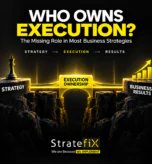
The challenge is that people performance cannot be owned by one department alone.
A Real Situation Many Businesses Relate To
During a recent engagement, a growing FMCG company approached us with what initially appeared to be an HR problem. Employee turnover had increased, morale was declining, collaboration between teams had weakened and leadership wanted to understand why retention had become a concern.
Like many organizations facing similar challenges, the initial assumption was straightforward. Employees were leaving, therefore HR needed to improve retention.
However, a deeper review revealed a different story.
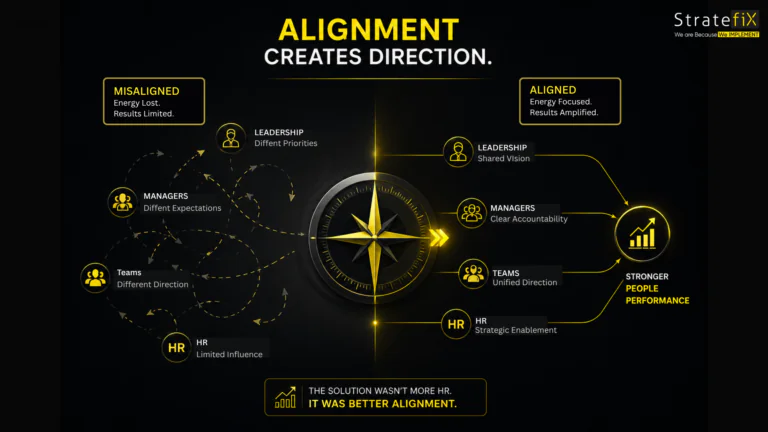
Different managers were operating with different expectations. Communication practices varied significantly across departments. Performance conversations were inconsistent, decision making authority was unclear and employees often received mixed messages depending on who they reported to.
The issue was not a lack of HR effort.
The issue was a lack of organizational alignment.
As clearer accountability structures were introduced, managerial ownership improved, communication processes became more consistent and people decisions became more system driven. Over time, the organization experienced a 28% improvement in key people performance indicators, along with stronger retention and better collaboration across teams.
Perhaps the most important lesson was that the solution did not come from HR alone.
It came from leadership, managers and HR collectively taking ownership of people outcomes.
The New Identity Crisis Nobody Is Talking About
As organizations continue adapting to change, HR is facing an entirely new set of expectations.
Artificial Intelligence is transforming workplaces faster than many organizations can adapt. Employees want to know how their roles may change, what skills they should develop, and what the future of work will look like. However, according to some report, only 34% of employees say leadership has clearly communicated how AI will affect their roles.
As a result, uncertainty continues to grow across organizations. Employees seek answers, managers look for direction, and leadership teams are still shaping their strategies. Increasingly, HR is expected to bridge that gap, despite many of these decisions being driven by broader business and technology priorities.
At the same time, research predicts that 25% of candidate profiles could be fake by 2028, creating new challenges around trust, verification and hiring decisions. Add growing concerns around employee wellbeing, with the same report highlighting an 83% burnout rate among workers globally and it becomes clear that the expectations placed on HR are expanding rapidly.
The role is no longer limited to hiring, policies and administration.
HR is increasingly expected to help organizations navigate uncertainty itself.
The Shift Businesses Need to Make
The solution is not giving HR more responsibility.
The solution is creating greater shared responsibility.
People performance should not be viewed as an HR metric. It should be viewed as a business metric.
Culture is shaped by leaders.
Engagement is influenced by managers.
Retention is affected by employee experiences.
Productivity is driven by systems, communication and accountability.
HR plays an important role in enabling these outcomes, but it cannot own them in isolation.
The strongest organizations understand this distinction. Instead of treating HR as the department responsible for fixing people problems, they create environments where leadership, managers and HR work together to influence people outcomes.
That shift changes everything.
Strong People Systems Create Stronger Businesses
The strongest organizations are rarely those with the most policies.
They are usually the ones with the clearest accountability.
Clear leadership.
Clear communication.
Clear expectations.
Clear ownership.
That’s the real challenge behind HR’s identity crisis.
The issue is not whether HR matters. The issue is whether organizations have aligned authority, accountability and ownership in a way that allows HR to be effective.
At Stratefix, we believe sustainable growth happens when people systems evolve alongside business systems. Just as organizations invest in operational excellence, financial discipline and strategic planning, they must also create structures that enable consistent people decisions across the business.
Because people performance has never been HR’s responsibility alone.
And perhaps recognizing that is the first step toward solving the identity crisis altogether.