“Bas ye task complete kar do.”
It sounds productive. In fact, most businesses operate this way every day.
Teams stay busy, deadlines keep moving, approvals happen continuously and everyone appears occupied. Yet despite all the activity, execution still feels slower than expected, mistakes continue to repeat and founders often find themselves involved in daily operations that should no longer require their attention.
This challenge is more common than many leaders realize. Research indicates that employees spend nearly 60% of their workday managing work rather than executing it. We’ve observed a similar pattern across growing businesses where increasing complexity leads to more follow-ups, overlapping responsibilities and slower execution.
And honestly, this is where many businesses unknowingly hit a ceiling. The issue is rarely a lack of effort. Teams are often hardworking and capable. The real challenge lies in how work is being managed.
Some businesses operate through task thinking, where the focus is on completing the next activity or solving the next issue. Others operate through process thinking, where the focus is on creating a repeatable system that consistently delivers results.
As businesses grow, that difference becomes one of the biggest factors determining whether a company scales smoothly or struggles with complexity.
Why Task Thinking Becomes a Growth Bottleneck
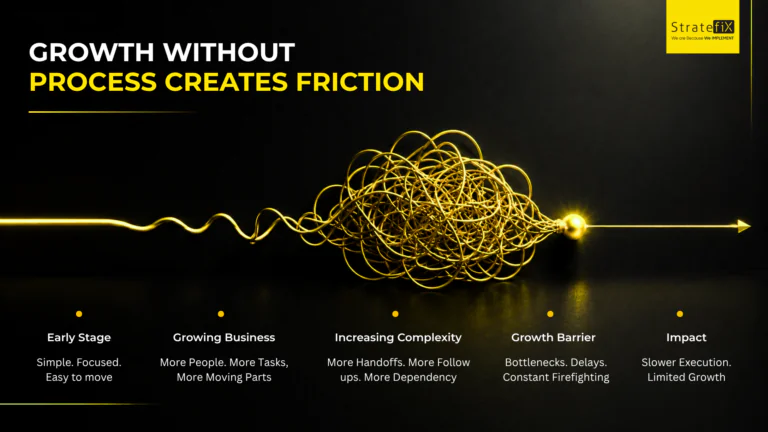
Task thinking often feels effective in the early stages of a business.
When teams are small and communication is simple, people can compensate for missing processes through extra effort. Problems get solved quickly, decisions happen informally and work continues moving forward.
However, growth changes the equation.
As businesses expand, task based execution starts creating hidden operational pressure. Teams become dependent on specific individuals, approvals become inconsistent and critical processes begin existing only on paper rather than within the organization itself. Over time, communication becomes fragmented and founders find themselves involved in decisions that should have been handled elsewhere.
The result is a business that remains busy but struggles to become truly scalable. This is why many founders experience a frustrating reality: everyone seems to be working hard, yet progress doesn’t feel proportional to the effort being invested.
The problem is not a lack of work.
The problem is a lack of process clarity.
The Hidden Cost of Task Thinking
One of the biggest challenges with task thinking is that it often creates short term solutions instead of long term operational stability.
In many growing businesses, teams become highly skilled at responding to problems quickly. Delays are followed up immediately, customer concerns are resolved and managers step in whenever issues arise. On the surface, everything appears to be functioning well because problems are constantly being addressed.
The real issue, however, lies beneath the surface.
The same challenges continue to reappear because the focus remains on solving individual situations rather than improving the process that created them. Teams spend significant time coordinating manually, chasing updates and relying on key individuals to keep work moving.
Over time, business experience repeated confusion, inconsistent execution, communication gaps and growing dependency on a handful of people. Even routine activities begin consuming unnecessary time and energy because there is no standard way of handling them.
Research involving 368 industrial and service companies found that organizations with stronger business process orientation and continuous process management consistently achieved better operational and organizational performance.
Strong businesses are rarely built by solving the same problems repeatedly. They are built by creating systems that prevent those problems from occurring in the first place.
A Real Situation Many Businesses Relate To
During a review engagement with a textile manufacturing company, we noticed a pattern that is quite common in growing businesses.
The company had regular production meetings, department heads were involved in operational discussions and most daily activities were getting completed. Yet certain issues kept resurfacing. Dispatch delays were discussed repeatedly, approvals often took longer than expected and the same operational challenges would appear in multiple review meetings.
Initially, each department had its own explanation. Production teams felt approvals were slowing things down. Operations teams believed information wasn’t reaching the right people on time. Management expected faster execution across departments.
However, after mapping the workflow, the actual issue became clearer.
Most activities were being managed as individual tasks rather than as part of a connected process. Different departments followed their own way of handling similar situations. Important approvals depended on specific individuals, follow ups happened through calls and messages and there was no consistent mechanism to track ownership once a decision was made.
As a result, work was moving, but not always in a predictable manner.
To address this, clearer process structures were introduced. Responsibilities were defined at each stage, review checkpoints were established and communication flows were standardized across departments. Approval pathways were clarified, escalation mechanisms were documented and teams gained better visibility into who was responsible for the next action.
Over the following weeks, discussions became more focused, follow-ups reduced and execution became more consistent because teams no longer had to rely on informal coordination to move work forward. The shift resulted in an estimated 34% improvement in execution efficiency, allowing departments to spend less time chasing updates and more time driving outcomes.
The biggest shift wasn’t that people started working harder.
The biggest shift was that work started flowing through a defined process instead of depending on constant intervention.
How Process Thinking Changes the Way Businesses Operate
Many businesses assume that processes make work more complicated.
In reality, its purpose is the opposite.
Process thinking exists to create simplicity.
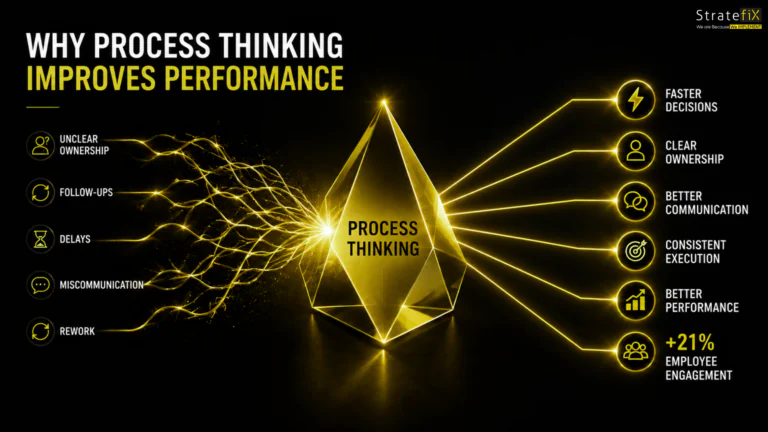
Instead of asking, “Who will handle this today?”, process thinking asks, “How can this be handled consistently every time?”. That shift changes the way businesses operate. Rather than reacting differently to each situation, teams create structured workflows that improve accountability, clarity and execution. Responsibilities become clearer, approvals move faster, communication becomes more consistent and collaboration improves.
Most importantly, businesses become less dependent on specific individuals. Scalability does not come from working harder every day. It comes from building systems that continue delivering results regardless of who is involved.
When processes become stronger, execution becomes more predictable.
And predictability creates growth.
Why Process Thinking Improves Performance
The benefits of process thinking are not just theoretical. They are supported by both research and practical business experience.
Studies involving hundreds of industrial and service companies concluded that process analytics, business process orientation and continuous process management are directly linked to stronger organizational performance.
When teams understand what needs to happen, who is responsible, where approvals occur and how issues should be escalated, decision-making becomes faster and execution becomes more consistent.
The benefits extend beyond operational efficiency. A Gallup survey found that organizations prioritizing structured processes and clarity in the way work gets done experience up to a 21% increase in employee engagement. This matters because engaged employees are more likely to take ownership, collaborate effectively and contribute consistently toward business goals.
Research also suggests that process-focused accountability improves performance in repeatable and structured tasks. This is particularly relevant because most business operations rely on repeatable activities such as approvals, reporting, onboarding and communication systems.
Task thinking also encourages another common challenge: multitasking.
Research from the American Psychological Association shows that multitasking can reduce productivity by as much as 40%. Process thinking reduces this chaos by creating structured workflows that allow teams to focus on execution instead of constant context switching.
As businesses grow, this becomes increasingly important because complexity without systems almost always creates confusion.
Strong Processes Create Stronger Businesses
The strongest businesses are not always the busiest ones.
They are usually the clearest ones.
Clear systems. Clear ownership. Clear communication. Clear execution flow.
That’s the real difference between task thinking and process thinking.
Task thinking helps businesses get through the day. Process thinking helps businesses build for the future. As organizations grow, sustainable growth requires consistency, accountability and a structured way of working that does not depend entirely on individual effort.
Sometimes the biggest operational transformation doesn’t begin with hiring more people or increasing effort. Sometimes it begins by redesigning how work flows through the business.
At Stratefix, we believe sustainable growth happens when businesses stop relying solely on individual effort and start building systems that make execution consistent, scalable and predictable.