Conflict exists in every growing business.
Not always visibly. Not always loudly.
But always present in some form. And the data makes it clear.
According to the CPP Report, when aligned with the Bureau of Labor Statistics’ average U.S. annual salary of $59,384 companies lose nearly $3,216.63 per employee each year in productivity. An organization with 500 employees loses an average of $1,608,315 Crore annually in productivity. These are not direct losses that can be easily tracked, but rather delays, misalignment and slowed momentum that build up over time.
But here’s the shift in perspective.
Conflict is not the problem. It’s how we experience and respond to it that defines growth.
The Founder’s Reality: Growth Brings Complexity
As businesses scale, leadership becomes less about doing and more about aligning. And this is where the Founder’s Dilemma (By Noam T. Wasserman) starts showing up. On one side, strong decision-making drives speed. On the other hand, collaborative thinking brings better perspectives. But balancing both is not easy.
In fact, studies show that startups with highly dominant CEOs tend to see 19% lower performance, while overly consensus driven teams often slow down execution. So, the challenge is not choosing one over the other. It’s more about creating alignment within the leadership team. Because growth is no longer an individual effort. It becomes a shared experience.
Conflict is a Signal, Not a Setback
In high performing teams, differences are natural. When passionate people care deeply about outcomes, different perspectives are bound to emerge. In fact, several studies from the Harvard Business Review consistently highlight that healthy disagreement often drives stronger innovation and better decision-making.
But when these perspectives are not aligned, they don’t create clarity.
They create friction.
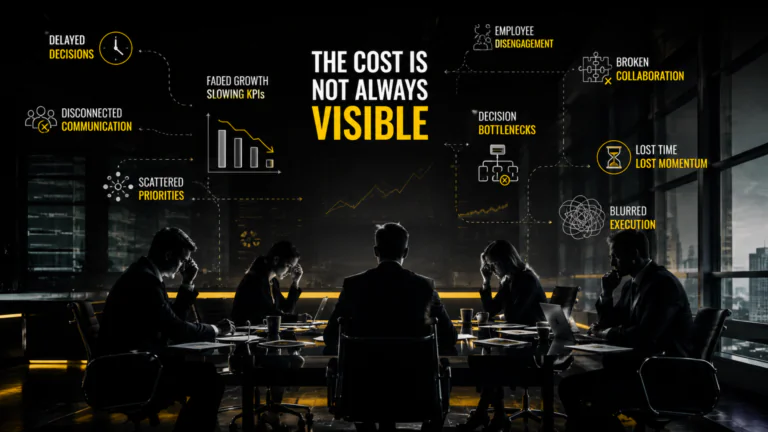
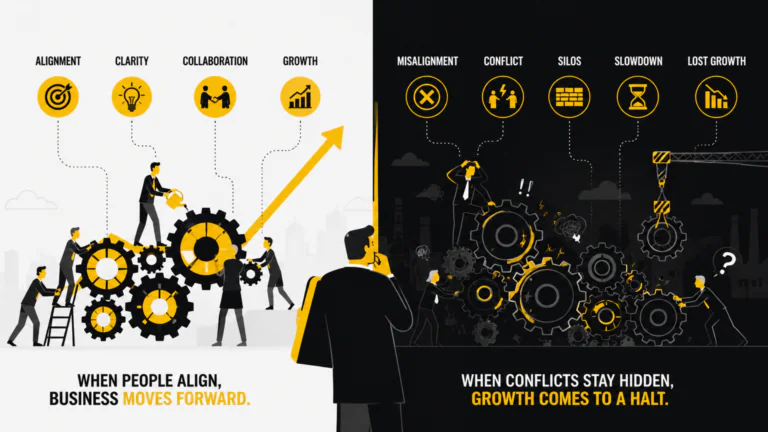
Not the kind that breaks the system, but the kind that slows it down. Decisions take longer. Ownership feels slightly unclear. Execution loses its sharpness.
And most of the time, this goes unnoticed. Because everything still looks like it’s working.
The Hidden Cost of “Almost Aligned” Teams
Conflict doesn’t always show up as arguments.
Sometimes, it shows up as disengagement.
Studies indicate that in environments where conflict is not handled well:
- 53% of employees experience workplace stress
- 77% feel disengaged
- People are 2x more likely to leave within a year.
This is not about failure. It is more about potential not being fully realized. Because when people are not aligned, they don’t stop working – they simply stop contributing to their highest level.
The interesting part? Most businesses search for solutions in processes, while the real answer often lies in people. More on that next.
So, what changes when conflict is resolved well?
It doesn’t start with an agreement.
It starts with clarity.
A conversation that once felt stretched suddenly becomes simple. People begin to listen not just to respond, but to understand. Perspectives that once felt like clashes start making sense in a larger picture.
And slowly, something shifts.
Decisions that used to take days now happen in minutes. Not because people are rushing but because they are aligned. There’s less second guessing, fewer back & forth loops and a stronger sense of direction.
Execution feels different too.
There’s more confidence in actions, more ownership in roles and less dependency on constant follow ups. Teams don’t just complete tasks they move with intent.
Nothing dramatic changes on the surface.
Same people. Same goals. Same business.
But internally, the experience of working together becomes smoother, lighter and more focused. Because when alignment steps in, friction quietly steps out. And when friction reduces, momentum doesn’t need to be pushed, it builds on its own.
The Penalty Principle: Why Consequences Matter
A defining feature of the Red Room is performance-linked penalties. This is essential. In most organizations, leadership operates without execution consequences. Targets exist, but enforcement is weak. The Red Room changes this dynamic. Targets are mandatory. Missing targets has defined consequences. This creates psychological seriousness. It aligns leadership behavior with organizational growth priorities. Without consequence, urgency weakens. As a consequence, execution strengthens.
The Deeper Layer: Emotional Intelligence
As teams begin to resolve conflict with more clarity, one thing becomes obvious that the shift is not just in decisions, but in how people engage with each other. Conversations feel more open, responses become more thoughtful and discussions that once felt heavy start moving with direction.
This is because conflict is rarely about the issue on the table. It is shaped by how individuals process situations, communicate their thoughts and respond in moments of difference. And that is where emotional intelligence plays a defining role.
It influences how leaders express disagreement without creating friction, how teams listen with intent instead of reacting instantly, and how accountability is taken with confidence rather than hesitation. These are not big, visible changes, but they quietly transform the way a team functions.
Because at its core, business is not just operational. It is human.
When emotional intelligence strengthens, conflict does not need to be avoided or controlled. It becomes easier to navigate. Conversations lead to clarity, differences bring better understanding, and alignment starts building naturally within the team.
And that is where conflict stops feeling like a challenge and starts becoming a part of how growth happens.
From Coordination To Connection
Most organizations operate through coordination.
Tasks are assigned.
Timelines are followed.
Updates are shared.
And that works…up to a point. But real growth needs something deeper. It needs connection.
A shared understanding of direction.
A sense of collective ownership.
A rhythm in how decisions are made.
Because when leaders are aligned, the organization doesn’t just work harder. It works smarter.
Where Experience Creates The Shift
Alignment cannot be forced.
It cannot be built through instructions alone.
It has to be experienced.
This is where MANAV™ (Management Alignment for Nurturing Aspiration & Vision) comes in.
At Stratefix, MANAV™ is designed as a human centric, experience driven intervention that works at the level where real change happens in how leaders think, interact and take ownership together.
Through high energy engagements, reflective discussions and structured accountability, it creates a space where alignment is not just discussed, but felt.
Because clarity is not told.
It is experienced.
And once experienced, it naturally reflects in how teams operate.
The ROI that actually matters
Yes, there are clear outcomes.
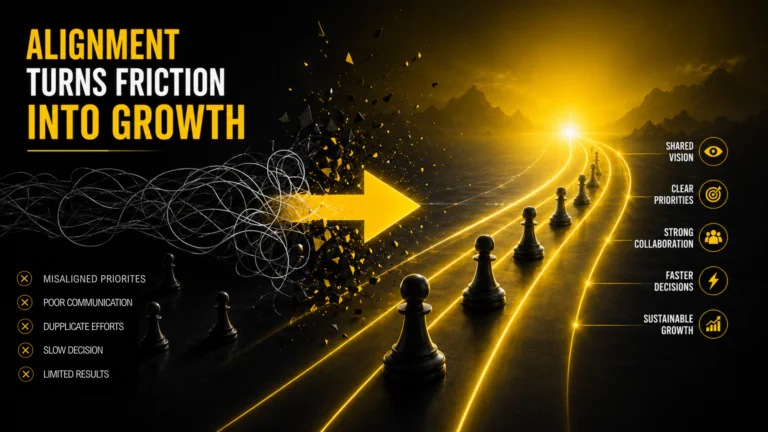
With MANAV™, businesses don’t just move faster they move with clarity. Decisions feel lighter, collaboration becomes more natural and leadership starts showing up across the team. In some industries, this shift has even led to up to 3x growth, simply by aligning people in the same direction.
And this is not just experience, it’s supported by data.
Nearly 45% of employees say productivity improves when leaders better understand resistance to change. Organizations that handle internal differences effectively also see higher productivity and stronger revenue growth, along with better team stability.
But the real ROI is not just in these numbers.
It shows up in the everyday flow of the business. Discussions don’t stretch unnecessarily. Ideas are shared more openly. Decisions carry clarity, not confusion. There is a sense of direction that everyone can feel.
At the same time, it’s important to understand that the absence of visible conflict doesn’t always mean everything is working perfectly. Sometimes, it simply means people holding back ideas stay unspoken, perspectives stay limited and growth loses its full potential.
When handled well, conflict doesn’t slow things down. It sharpens thinking. It strengthens alignment. And that’s where the real return comes from not just better results, but a business that moves with clarity, confidence, and consistency.
Growth is an Experience before it becomes a Result
Conflict resolution is not about avoiding disagreement.
It’s about unlocking alignment.
Because when leaders align emotionally, psychologically and strategically, the entire organization follows. And growth stops feeling like something you constantly push for. It becomes something you build together.
That’s the real ROI.
Not just better results. But a better way of growing.