India’s digital economy is no longer a distant dream, it is a $1 trillion reality projected by 2030. According to Business Insider, this surge is fueled by a massive boom in e-commerce and global services exports, which Goldman Sachs predicts will reach $800 billion by 2030.
At the heart of this transformation is Artificial Intelligence (AI). A report by EY suggests that AI adoption could add between $359 billion and $438 billion to India’s GDP by 2030. This isn’t just for tech giants; it is a golden opportunity for Small and Medium Enterprises (SMEs) to unlock exponential growth.
Quick Recap: What We Covered in Part 1
In [Part 1 of our series], we explored the digital boom in India and how automation empowers MSMEs in Manufacturing, Engineering, and Textiles. We discussed the concept of “First Time Right” (FTR) and how simple tech can eliminate costly rework.
Why AI Adoption Is Critical for Indian SMEs
According to the International Trade Administration (ITA), India has unique strengths that make it a fertile ground for AI:
- A Scorching AI Market: Projected to reach $8 billion by 2025 with a 40% CAGR.
- Skilled Talent Pool: India boasts a vast workforce of tech-savvy professionals.
- Digital Infrastructure: Initiatives like Digital India have provided the backbone (5G, UPI, Cloud) needed for AI adoption.
Practical AI Use Cases: Transforming Traditional Industries
AI is moving beyond the “experimental” phase and into the practical functions of everyday business. Here is how different sectors can leverage these technologies:
1. Agriculture
Precision farming uses AI to analyze soil health and weather patterns. By collaborating with US aggrotech firms, Indian SMEs can deliver AI-driven solutions directly to farmers to boost crop yields.
2. Finance & Fintech
The financial sector uses AI for fraud detection, risk assessment, and customer service automation. Partnering with US fintech companies allows Indian banks to secure transactions and provide 24/7 support via intelligent bots.
3. Healthcare
AI is revolutionizing diagnostics and personalized treatment. NASSCOM is currently promoting AI-driven healthcare solutions, opening doors for predictive diagnostics, and faster drug discovery.
4. Retail and E-commerce
Chatbots and recommendation engines are the new standard. By analyzing buyer behavior, AI helps retailers personalize the shopping experience, leading to higher conversion rates.
5. Manufacturing
Predictive maintenance and AI-powered quality control ensure that machines don’t break down unexpectedly, boosting operational efficiency across the board.
Case Study: Shanti Chemicals (Chemical Industry)
Located in Ankleshwar, Gujarat, Shanti Chemicals is a family-run business that faced inconsistent product quality and safety risks due to manual processes.
By partnering with Stratefix Consulting, they implemented:
- LIMS (Laboratory Information Management System): To manage data and ensure regulatory compliance.
- Safety Management Software: To track hazardous materials and minimize accidents.
- Predictive Maintenance: To stop equipment failures before they happened.
The Result: Consistent product quality, a safer workplace, and streamlined compliance.
Greenfield Businesses: Starting Digital-First
New ventures (Greenfield) have a unique advantage: they can build a digital foundation from day one. Let’s look at Akash, the founder of “Ecoware” (eco-friendly disposable tableware).
By avoiding traditional manual hurdles, Akash used:
- Cloud-Based Infrastructure: For cost-effective scaling.
- Agile Development: To adapt products quickly to market trends.
- Big Data Analytics: To understand exactly what eco-conscious consumers want.
The Result: Ecoware reached a nationwide customer base much faster than a traditional brick-and-mortar business ever could.
Consumer Goods (FMCG): Reaching Every Household
Traditional retailers, like Mrs. Sharma who runs a Kirana store in Mumbai, can now compete with giants. To expand from 3 locations to 10+, she utilized:
- D2C (Direct-to-Consumer) Platforms: Selling online to reach customers beyond their neighborhood.
- Social Media Marketing: Partnering with influencers to build brand trust.
- Supply Chain Traceability: Using digital tools to track product movement and ensure freshness.
Challenges SMEs Face While Adopting AI
While the potential is huge, SMEs often encounter hurdles:
- Cost Concerns: Perception that AI is too expensive.
- Skill Gap: Difficulty in finding internal staff to manage new systems.
- Data Security: Protecting sensitive business data from cyber threats.
- Resistance to Change: Shifting the organizational culture from “manual” to “digital.”
Government and Industry Initiatives Supporting AI
The Indian government is actively lowering these barriers through:
- Digital India: Expanding internet access to rural hubs.
- NASSCOM AI Gamechangers: Programs that highlight successful AI implementations in SMEs.
- US-India Collaborations: Trade partnerships that allow Indian firms to access advanced Western AI tech.
Cost-Effective AI Tools for Small Businesses
You don’t need a multimillion-dollar budget to start. Many SMEs use:
- AI Chatbots: For automated customer service.
- Inventory Management AI: To predict stock requirements.
- CRM with Predictive Analytics: To identify which leads are most likely to buy.
Conclusion: Embrace the Digital Revolution
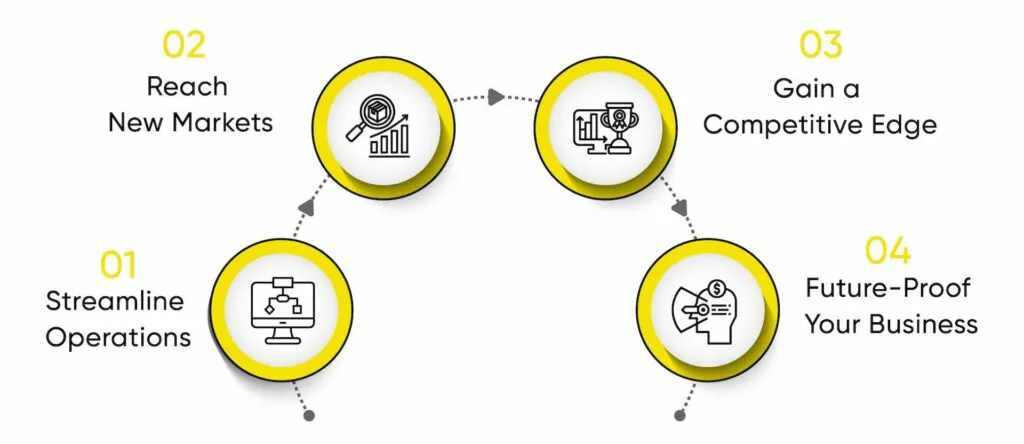
The digital revolution isn’t coming, it’s here. By embracing technology and partnering with a growth consultant like Stratefix Consulting, your MSME can:
- Streamline Operations: Reduce costs through automation.
- Reach New Markets: Use e-commerce to sell globally.
- Gain a Competitive Edge: Offer better customer experiences than your competitors.
- Future Proof: Stay relevant in an ever-evolving market.
From Zero to Shark Tank Hero: Our client, Alpino Health Foods, cracked offline sales and scaled massively by adopting the right digital strategies with Stratefix.
Final Thoughts on AI-Driven Growth for SMEs
The path to $1 trillion is paved with data. Don’t navigate the digital maze alone. With expertise across 75+ industries, Stratefix Consulting provides:
- Needs Assessment: We find your specific technology gaps.
- Custom Roadmaps: Solutions that fit your existing workflow.
- Implementation Support: We help build your team’s internal capacity.
Are you ready to join the 550+ businesses that have experienced the Stratefix Advantage?