How Stratefix helped a growing fashion business establish structured HR systems, improve role clarity, strengthen employee development and build a foundation for more effective management.

The fashion and textile industry is dynamic and highly competitive. Businesses operating across retail and e-commerce channels must coordinate products, inventory, employees, customer requirements and day-to-day operations while responding to changing market demands.
As businesses expand, their management practices must evolve alongside their operations. Informal processes and individual experience may support early growth, but managing a larger organisation requires clearer responsibilities, structured people management and consistent performance reviews.
A growing fashion and e-commerce business in Gujarat recognised the need to strengthen its internal management systems to support its next stage of development.
Stratefix Consulting partnered with the organisation for a six-month engagement focused on strengthening HR governance, defining organisational responsibilities, introducing employee development initiatives and establishing more structured management practices.
The objective was to build the organisational foundations required for more consistent execution, stronger accountability and sustainable growth.
The Challenge: Strengthening the Organisation Across Multiple Areas
The engagement identified several interconnected areas where the organisation needed greater structure and consistency.
1. HR Governance and Process Formalisation
HR practices and employee-related processes were largely informal, with limited documentation of policies and standard procedures. The organisation needed a more consistent framework for managing employee matters and supporting HR governance.
2. Organisational Structure and Role Clarity
Responsibilities and performance expectations needed clearer definition. The organisation required a structured framework connecting job roles, departmental responsibilities and business objectives.
3. Employee Development and Capability Building
Employee training, mentoring and individual development needed a more systematic approach. Structured learning initiatives were required to support capability development and encourage continuous improvement.
4. Performance Management and Accountability
The organisation needed more formal mechanisms to define expectations, review responsibilities and assess performance. Clearer performance frameworks could help connect individual contributions with organisational priorities.
5. Reporting and Management Reviews
Management reporting, task tracking and delegation required greater structure. Leadership needed practical tools and more consistent review mechanisms to improve visibility into responsibilities, progress and execution.
Together, these challenges highlighted the need for an integrated organisational improvement initiative rather than isolated HR interventions.
The Stratefix Approach: From Diagnosis to Implementation
Stratefix followed its Advising + Execution approach, working with the organisation’s leadership and internal project champions to develop practical frameworks and introduce supporting management tools.
The six-month engagement covered five major areas of organisational development.
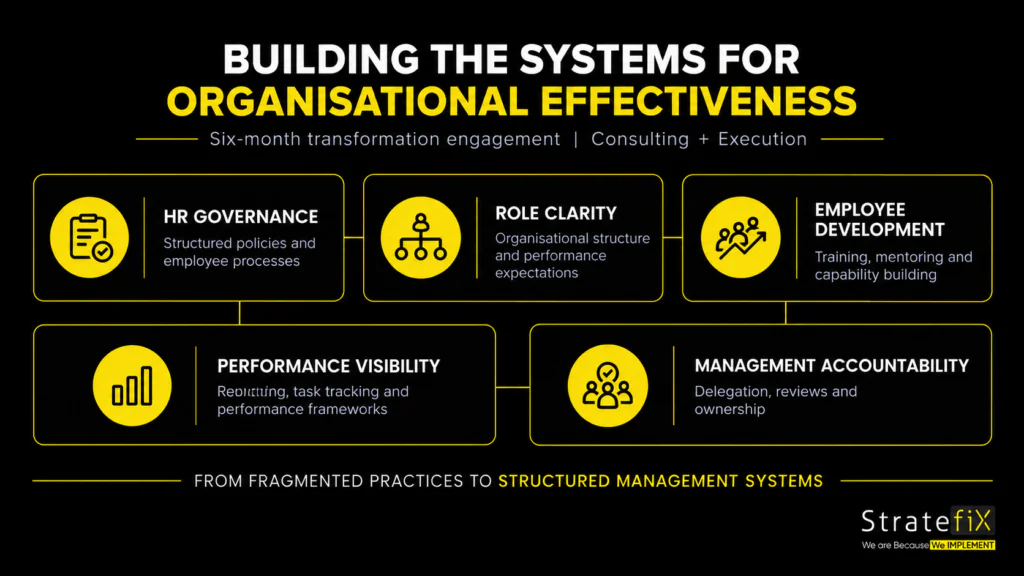
1. Establishing a Structured HR Framework
Stratefix developed a formal HR policy framework covering key employee processes, including:
- Attendance and leave management
- Recruitment and employee referrals
- Employee loans and advances
- Retention practices
- Rewards and recognition
- Code of conduct
- Onboarding documentation
The objective was to establish documented processes that could support greater consistency in employee management and day-to-day HR administration.
Outcome: A structured HR governance framework was established to support more systematic people management.
2. Defining Organisational Structure and Performance Expectations
To strengthen organisational clarity, the engagement included work on:
- Organisational structure
- Job descriptions
- Key Result Areas (KRAs)
- Key Performance Indicators (KPIs)
- Objectives and Key Results (OKRs)
- Responsibility mapping
- Mission, vision, values and organisational goals
These frameworks were intended to create stronger alignment between organisational priorities, departmental responsibilities and individual performance expectations.
Outcome: Organisational and performance-management frameworks were established to support clearer responsibilities and accountability.
3. Introducing Employee Development Initiatives
Recognising the importance of employee capability, Stratefix supported the introduction of structured development activities, including:
- Employee training and mentoring
- Personal Development Plans (PDPs)
- Onboarding and learning initiatives
- Packaging-team training
- Kaizen practices
- A seven-day computer-based learning programme
The engagement also included employee interactions and satisfaction analysis to inform people-management and development priorities.
Outcome: Employee learning and development initiatives were introduced, providing a more structured foundation for capability building and continuous improvement.
4. Strengthening Performance Tracking and Reporting
Practical management tools were developed to support the monitoring of responsibilities, performance and execution.
These included:
- Manpower planning sheets
- Employee rating sheets
- Task-tracking sheets
- Delegation sheets
- Performance discussions
- Business dashboard reviews
The emphasis was on creating more organised information and review mechanisms to help management assess progress and identify areas requiring attention.
Outcome: More structured reporting and performance-tracking mechanisms were established to support management visibility.
5. Improving Management Reviews and Delegation
The engagement also focused on strengthening management practices through task reviews, delegation discussions, management assessments and employee interactions.
These activities supported a more structured approach to reviewing responsibilities, discussing progress and reinforcing ownership.
Outcome: Management review and delegation practices gained a more defined framework, creating a foundation for stronger accountability and more consistent execution.
The Results: Measurable Progress Across Key Areas
At the conclusion of the engagement, the project casebook recorded the following consultant-assessed implementation achievements.
Transformation Area | Recorded Achievement |
HR Governance | 90% |
Role Clarity & Performance Management | 85% |
Employee Development | 90% |
Employee Engagement | 85% |
Reporting Mechanism | 80% |
Management Review | 85% |
Overall Transformation Progress | Approximately 85% |
These percentages represent the project’s recorded assessment of implementation progress. They should not be interpreted as independently verified improvements in productivity, profitability, revenue or employee performance.
Key Organisational Outcomes
The six-month engagement established frameworks and supporting tools across several areas of organisational management.
More Structured HR Governance
Documented policies and supporting processes created a foundation for more consistent employee management.
Clearer Organisational and Performance Frameworks
Organisational structure, job descriptions and performance-management frameworks provided a basis for defining responsibilities and expectations.
Structured Employee Development
Training, mentoring and learning initiatives introduced a more organised approach to employee capability development.
Improved Reporting Mechanisms
Manpower, rating, task and delegation sheets established more structured ways to track responsibilities and support management reviews.
More Defined Management Practices
Task reviews and delegation discussions provided a framework for more structured management oversight and accountability.
Collectively, these interventions addressed people, performance and management processes as connected parts of organisational effectiveness.
The Business Significance
For a growing fashion and e-commerce business, organisational effectiveness is closely connected to the ability to coordinate people, processes and priorities.
Formal HR systems can support greater consistency in employee management. Clearer roles can reduce ambiguity around responsibilities. Employee development can help strengthen workforce capabilities, while structured reporting and reviews can support more informed management decisions.
Over time, these capabilities can help reduce operational friction, improve the use of management time and create a stronger foundation for operational efficiency and sustainable profitability.
The casebook documents the implementation of management frameworks and supporting practices. It does not quantify the resulting change in operational efficiency, leadership involvement or financial performance. Those longer-term business benefits should therefore be viewed as objectives the systems are designed to support, rather than verified outcomes of this engagement.
Building for the Next Stage of Growth
The engagement established important foundations, while several areas remained priorities for continued development.
These included strengthening HR analytics and management information systems (MIS), advancing performance-management practices, developing a skill matrix, formalising grade and career structures, and maintaining regular HR governance reviews.
Continued attention to these areas would help the organisation build on the frameworks established during the engagement and support their consistent adoption across the business.
The Stratefix Perspective
Organisational growth requires more than capable people and strong market opportunities. It also requires the systems that connect individual responsibilities with business priorities.
This engagement demonstrates Stratefix Consulting’s Consulting + Execution approach to organisational development: identifying management gaps, designing practical frameworks and working with leadership to introduce the processes and tools needed to address them.
By bringing HR governance, role clarity, employee development, performance management and reporting into one engagement, Stratefix helped establish a more structured foundation for managing the organisation.
Because building a stronger business requires more than defining what needs to change. It requires putting the right systems into practice.