Imagine building a skyscraper. You have the finest marble, the strongest steel, and a vision of a tower that touches the clouds. But when the construction crew arrives, there is no blueprint. The plumbers are trying to lay bricks, the architects are mixing cement, and the foreman is busy personally tightening every single bolt on the third floor instead of overseeing the entire project.
What happens? Chaos. Delays. A structure that might look okay from a distance but is fundamentally unstable.
This is exactly what happens in many businesses today. Entrepreneurs and managers often have incredible products and ambitious goals, but they lack the two structural pillars required to support them: a clear organizational structure and the art of delegation.

The Foundation: Understanding Organizational Structure
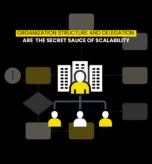
Organizational structure is much more than just an “org chart” with boxes and lines. It is the framework that defines how activities such as task allocation, coordination, and supervision are directed toward the achievement of company goals.
Think of it as the operating system of your business. Without it, your “hardware” (people and resources) cannot function efficiently.
Why Structure Matters:
- Clarity of Command: Everyone knows who they report to and who reports to them. This eliminates the “too many cooks in the kitchen” syndrome.
- Efficiency in Communication: A clear structure creates established channels for information. It prevents vital data from getting lost in the “noise” of a disorganized office.
- Accountability: When roles are clearly defined, it is easy to track who is responsible for what. Successes can be celebrated, and bottlenecks can be identified quickly.
- Scalability: You cannot grow a “one-man show” into a multimillion-dollar enterprise without a structure. A defined hierarchy allows you to plug in new talent as the company expands without disrupting the existing flow.
Choosing Your Framework: Types of Organizational Structures
Not every business should be structured the same way. The right “shape” for your company depends on your industry, size, and goals. Here are the four primary types, along with real-world scenarios handled by consulting experts.
1. Functional Structure
This is the most common structure, where the organization is divided into specialized departments like Marketing, Finance, Operations, and HR.
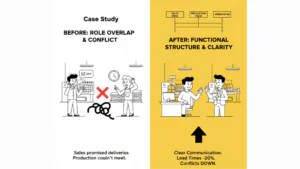
- Case Study: A mid-sized textile manufacturer was struggling with “role overlap.” The sales team promised delivery dates that the production team couldn’t meet because they weren’t talking about. By implementing a formal Functional Structure, the firm established clear departmental heads. Communication protocols were put in place so that Sales had to get a “green light” from the Production Head before confirming bulk orders.
- Result: Lead times dropped by 20% and internal conflicts decreased significantly.
2. Divisional Structure
Common in large companies, this structure groups for employees based on specific products, services, or geographical locations. Each division operates almost like its own mini company.
- Case Study: A consumer goods company sold both electronics and organic snacks. Using one management team for both was a disaster because the supply chains were totally different. A restructure into Product-Based Divisions allowed the “Electronics Division” and “Food Division” to have their own dedicated logistics and marketing teams.
- Result: Both divisions saw a 15% increase in profitability because they could finally make decisions tailored to their specific markets.
3. Matrix Structure
In this setup, employees have dual reporting relationships, usually to a functional manager and a product/project manager. It’s complex but highly flexible.
- Case Study: A specialized engineering firm worked on multiple high-stakes infrastructure projects simultaneously. Engineers needed to stay part of their “Engineering Department” for technical growth but needed to report to “Project Alpha” for daily tasks. A Matrix Structure was introduced to balance technical excellence with project deadlines.
- Result: Resource utilization improved, as engineers could be shifted between projects based on urgency without losing their departmental home.
4. Flat (Horizontal) Structure
This structure removes middle management levels, leaving very little space between the staff and the executives. It’s popular in startups to encourage speed and creativity.
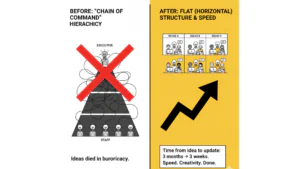
- Case Study: A tech startup found that ideas were dying in a “chain of command.” They shifted to a Flat Structure where small, autonomous squads handled specific app features.
- Result: The time from “idea” to “app update” was cut from three months to three weeks.
The Engine of Growth: The Importance of Delegation
If the organizational structure is the blueprint, then delegation is the engine that moves the project forward.
Many leaders struggle with the “Super-Hero Complex.” They believe that if they want something done right, they must do it themselves. While this might work when you have three employees, it becomes a growth-killer when you have thirty.
Delegation is the strategic transfer of authority and responsibility to another person. It is not just “giving work”; it is building capacity.
The Benefits of Effective Delegation:
- Time for Strategy: Every hour a CEO spends on basic operations is an hour lost on strategic planning and high-level growth.
- Empowerment: When you delegate, you tell your employees, “I trust your judgment.” This boosts morale and fosters a culture of ownership.
- Skill Development: Delegation is the best form of on-the-job training for the next generation of leaders.
- Faster Decision Making: If every small decision has to go through the owner, the business moves at a snail’s pace.
Case Study: From Chaos to Control
To understand how these concepts work in tandem, let’s look at a transformation project performed for a family-owned manufacturing client.
The Challenge:
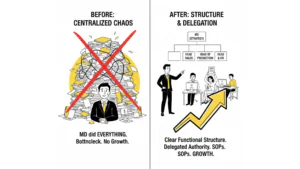
The client had grown rapidly, but the “founder-centric” model was breaking down. The Managing Director (MD) was working 14 hours a day, yet production was stalling and employee turnover was high. Factory workers were going directly to the MD to ask for permission for minor expenses, and every single invoice required his physical signature, leading to massive delays.
The Intervention:
A structural re-engineering was performed:
1. Redefining the Org Chart:
A clear Functional Structure was introduced. Each department was given a head with specific Key Result Areas (KRAs). If an employee can do a task at least 70% as well as the leader, it should be delegated. Financial authorities were decentralized, allowing department heads to approve expenses up to a certain limit.
2. Standard Operating Procedures (SOPs):
To ensure quality remained high, SOPs were created for every major process. This gave the MD peace of mind that tasks were being done correctly without his constant supervision.
The Result:
Within six months, the MD’s operational workload dropped by 60%. This allowed him to focus on a new export strategy that eventually increased revenue by 25% within the first year.
Common Pitfalls to Avoid
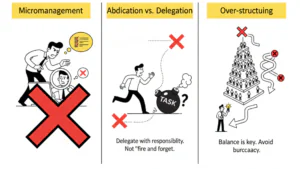
- Micromanagement: Delegating a task but then hovering over the person’s shoulder is not delegation; it’s just annoying. Set the expectation, provide the resources, and step back.
- Abdication vs. Delegation: Delegation does not mean “fire and forget.” You still hold the ultimate accountability. You must have “check-in” points to monitor progress.
- Over-structuring: Don’t create so many layers of management that it takes three weeks to get a simple idea approved. Balance is key.
How Stratefix Consulting Can Help
Transitioning from a chaotic, owner-dependent model to a streamlined, professional structure is a journey, and you don’t have to walk it alone. Stratefix Consulting specializes in turning organizational “mess” into organizational “messages.”
We don’t just hand you a report; we work alongside you to design a customized organizational structure that fits your unique culture. From defining KRAs and KPIs for your team to implementing robust delegation frameworks and SOPs, we ensure your business is built on a foundation that can support exponential growth. Whether you are an SME looking to professionalize or a large firm looking to optimize, Stratefix Consulting has the expertise to help you build a self-sustaining organization that thrives even when you aren’t in the room.
Conclusion: Building for the Future
Business success isn’t just about having the best idea; it’s about having the best system to execute that idea. A solid organizational structure provides the “where” and “who,” while effective delegation provides the “how” and “when.” When you move from being a “doer” to a “leader,” you stop being the bottleneck and start being the catalyst for growth.