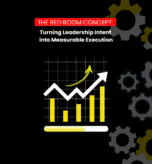
In every growing business, there comes a stage where strategy is not the problem; execution is. The Red Room is not a workshop. It is not training. It is not theoretical learning. It is a controlled execution environment created specifically for director-level leadership teams, where execution becomes non-negotiable and measurable within days. Leadership teams know what needs to be done. They know which clients need follow-ups, which partnerships must be closed, which approvals are pending, and which decisions can unlock growth. Yet, despite clarity, execution gets delayed. Not due to lack of capability. Not due to lack of intent. But due to lack of urgency, focus, and structured execution. This is the exact problem the Red Room Concept is designed to solve.
As organizations scale, leadership roles evolve. While this shift is necessary, it creates a hidden execution gap. This happens because leadership attention gets fragmented across multiple priorities:
- Operational firefighting consumes bandwidth
- Internal meetings replace external action
- Important follow-ups get postponed
- Strategic calls remain pending
- Decisions wait for “the right time”
- Process bottlenecks remain unresolved
What Is the Red Room?
The Red Room is a structured execution intervention designed exclusively for director-level teams. Leadership is temporarily removed from their regular office environment and relocated to a neutral, distraction-free external setting for 2–3 days. This physical and psychological shift is intentional. The regular office carries operational noise, comfort patterns, and habitual distractions. The external environment creates psychological seriousness and removes escape routes. Inside the Red Room, leadership is not there to discuss plans. They are there to be executed.
The Red Room operates on five non-negotiable principles:
1. Numerical Targets, Not General Intentions
Every leader is assigned clear, measurable execution targets such as number of strategic calls, client follow-ups, decision closures, or pipeline conversions.
2. Structured Execution Blocks
The day is divided into high-intensity execution windows where leaders focus only on defined tasks.
3. Real-Time Accountability
Progress is tracked live. Output is visible. There is complete transparency in execution.
4. Performance-Linked Consequences
Targets are mandatory. Penalties apply if targets are missed. This ensures seriousness and removes optional behavior.
5. End-of-Day Performance Review
Each day concludes with a structured review and accountability assessment.
This is not motivational. This is operational.

Why the Red Room Works: The Psychology Behind It
Execution failure is rarely due to lack of knowledge. It is due to a lack of urgency and consequences.
In regular environments, leadership operates with flexibility. Tasks can be postponed. Follow-ups can be delayed. Decisions can wait. The Red Room removes this flexibility.
It creates:
- Environmental seriousness
- Time-bound pressure
- Visible accountability
- Consequence-based execution
This shifts leadership from comfort-based behavior to performance-based behavior.
It is not merely a productive intervention. It is a mindset intervention.
Leaders experience a fundamental shift from “I will do this soon” to “This must be completed now.” Once this execution mindset is experienced, it carries forward beyond the Red Room.
Case Study 1: Manufacturing Company – Unlocking Stalled Revenue Pipeline
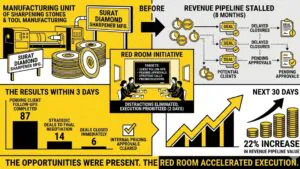
A mid-sized sharpening stone and tool manufacturing company in Surat had a strong market presence, but stagnant revenue growth for over eight months.
The leadership team had multiple large potential clients in discussion, but closures were delayed. Follow-ups were inconsistent. Approvals were pending internally. The problem was not opportunity. It was execution velocity. The leadership team entered the Red Room for three days.
Each director was assigned measurable targets:
- Number of client follow-ups
- Pending approval closures
- Strategic partner calls
- Pricing decision finalizations
Inside the Red Room environment, distractions were eliminated and execution became the only priority. The results within three days:
- 87 pending client follow-ups completed
- 14 strategic deals moved to final negotiation stage
- 6 deals closed immediately
- Internal pricing approvals cleared
Within the next 30 days, the company saw a 22% increase in revenue pipeline value. The opportunities were already present. The Red Room accelerated execution.
Case Study 2: How Execution Discipline Increased Conversions by 72% and Accelerated Revenue Pipeline
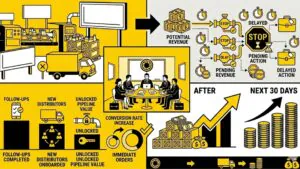
An FMCG company faced stalled growth despite strong distributor demand.
- Over 420 follow-ups and
- ₹4.8 crore potential annual revenue was pending due to delayed leadership action.
During a 1.5-day execution intervention, directors were assigned mandatory follow-up and closure of targets with strict accountability. Leadership completed:
- 427 follow-ups
- onboarded 54 new distributors and
- unlocked ₹2.7 crore pipeline value.
Conversion rate increased from 18% to 41%, and ₹96 lakh immediate orders were secured. Within 60 days, revenue grew by 28%. The intervention proved that when leadership shifts from oversight to structured execution, revenue acceleration and pipeline movement improve significantly.
The Penalty Principle: Why Consequences Matter
A defining feature of the Red Room is performance-linked penalties. This is essential. In most organizations, leadership operates without execution consequences. Targets exist, but enforcement is weak. The Red Room changes this dynamic. Targets are mandatory. Missing targets has defined consequences. This creates psychological seriousness. It aligns leadership behavior with organizational growth priorities. Without consequence, urgency weakens. As a consequence, execution strengthens.
Red Room Is Not a Workshop- It Is Execution Infrastructure
Workshops focus on learning. The Red Room focuses on execution. Workshops discuss what should be done. The Red Room ensures it gets done. Workshops create ideas. The Red Room creates outcomes. This distinction is critical. The Red Room does not aim to increase knowledge. Leadership already has knowledge. It creates an environment where leadership converts knowledge into measurable output.
Immediate and Long-Term Impact
The Red Room delivers results at two levels.
Immediate Impact
- Long-pending tasks get completed
- Follow-ups get executed
- Decisions get finalized
- Pipeline momentum increases
- Revenue opportunities accelerate
Long-Term Impact
- Leadership execution discipline improves
- Decision-making speed increases
- Accountability culture strengthens
- Comfort-zone leadership patterns break
- Execution mindset becomes permanent
Leadership begins to operate with higher urgency and clarity even after the Red Room intervention ends.

Why This Is Designed Only for Director-Level Leadership
Execution velocity in any organization is determined at the top. Employees execute based on leadership direction. If leadership execution slows down, organizational momentum slows down.
The Red Room focuses on directors because:
- Directors control strategic decisions
- Directors influence execution culture
- Directors unlock growth bottlenecks
- Directors control high-value opportunities
When leadership execution accelerates, organizational execution follows.
This creates a cascading performance effect across the company.
The Mindset Shift: From Comfort-Driven to Performance-Driven Leadership
The most powerful outcome of the Red Room is mindset transformation.
Leadership moves from:
- Flexible timelines → Fixed timelines
- Intent-based execution → Target-based execution
- Comfort-driven behavior → Performance-driven behavior
- Passive pipeline management → Active pipeline control
Leaders rediscover execution of intensity. They realize that growth acceleration is not dependent on external factors, but on internal execution velocity.
Conclusion: Execution Is the Ultimate Competitive Advantage
Most businesses do not fail due to lack of ideas. They fail due to lack of execution intensity. Opportunities exist. Strategies exist. Plans exist. What is missing is structured, accountable, and consequence-driven execution. The Red Room creates this structure.
It forces clarity. It creates urgency. It enforces accountability. It delivers measurable output. Within days, leadership moves from discussion mode to execution mode. Because ultimately, growth does not come from planning more. Growth comes from executing what needs to be done. And inside the Red Room, execution becomes non-negotiable.