How a structured implementation approach improved inventory accuracy, material visibility, workplace organisation and operational discipline.
When Inventory Records and Ground-Level Operations Need to Work Together
In a textile manufacturing business, knowing how much material is available is only part of inventory management. Teams also need to identify the right material, locate it when required, record its movement and ensure that physical stock matches the information maintained in the system.
When hundreds of SKUs and multiple fabric categories move through warehouse, folding, processing and dispatch operations, even small inconsistencies can create complications. Different names for the same material, gaps between physical stock and software records, unclear storage arrangements and inconsistent daily reporting can make routine operational decisions more difficult.
At this textile manufacturing business, these areas presented an opportunity to strengthen inventory management and improve the way warehouse and operational activities were controlled.
The requirement was not limited to correcting stock records or reorganising storage areas. It was to establish a more structured operating framework in which material could be identified and verified consistently, daily activities could be tracked through standard reports, and teams had clear responsibilities for maintaining the processes.
Stratefix Consulting worked alongside the internal team to translate these priorities into practical systems and support their implementation.
Understanding the Gaps Before Implementing Solutions
The engagement began with Gemba walks across warehouse and operational areas. Existing processes were observed and mapped to understand how inventory was identified, counted and recorded, how material was stored and moved, and how operational information was communicated.
The assessment highlighted five connected areas requiring attention:
- Inventory accuracy: Physical stock and software records required systematic verification and reconciliation.
- Material identification: Multiple names for the same material and inconsistent coding practices made identification and tracking more difficult.
- Warehouse organisation: Storage locations, material placement, tagging, floor marking and visual controls needed standardisation.
- Operational reporting: Reporting formats, timely updates and employee understanding of reporting requirements needed improvement.
- Process ownership and monitoring: Responsibilities, audit frequency and corrective-action follow-up required clearer definition.
These were not isolated issues. Inventory records, physical storage, reporting and accountability all influenced how effectively the operational team could manage everyday activities.
Based on these observations, an implementation roadmap was developed covering process assessment, system design, implementation, monitoring and handover.
Translating Operational Priorities into Practical Systems
The focus was on implementing processes within the existing operating environment, rather than producing recommendations that would remain separate from everyday work.
1. Creating a More Structured Inventory Management System
Inventory identification and verification were among the first priorities.
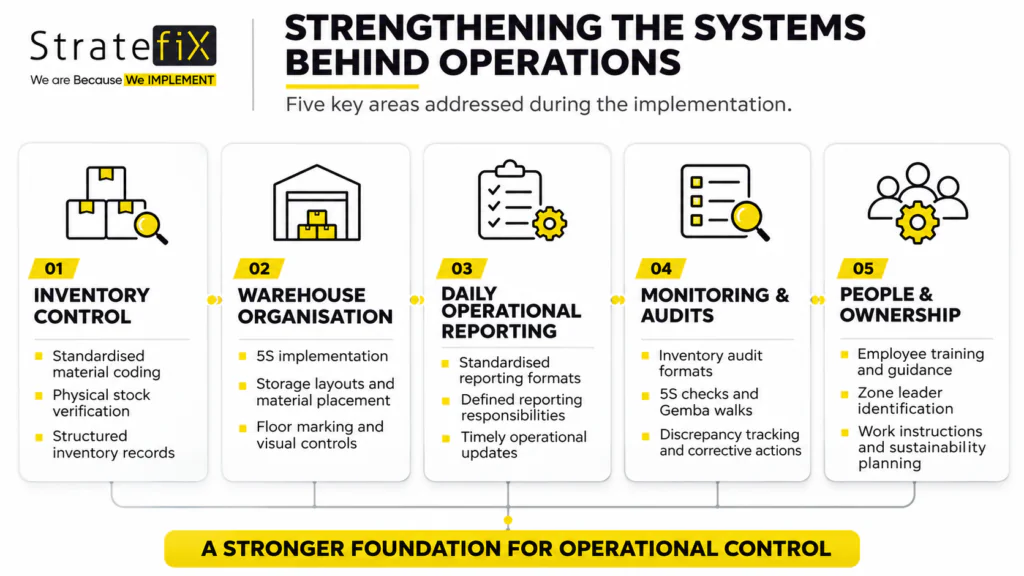
The team developed inventory counting and verification formats and standardised material coding to address inconsistencies in how materials were identified. Physical stock verification was carried out, with inventory categorised and recorded through a more consistent approach.
During implementation, approximately 5.59 lakh metres of inventory across 704 SKUs were counted, SKU-coded and entered into the existing Frontline software.
The inventory covered:
- 481 Dyed Woven SKUs
- 119 RFD Woven SKUs
- 94 Dyed Knits SKUs
- 8 RFD Knits SKUs
- 2 Digital SKUs
This exercise established a more structured inventory record for the categories covered. It also provided a consistent basis for identifying materials, reviewing stock information and carrying out further verification.
2. Improving Warehouse Organisation and Material Visibility
Reliable inventory records need to be supported by an organised physical environment. Material identification becomes more useful when teams can also locate and store items according to defined arrangements.
The team introduced the 5S methodology through employee training and practical implementation across warehouse and sample areas.
The initial activities focused on sorting materials and improving their arrangement. Set in Order activities progressed through storage layouts and defined material placement. Supporting work included warehouse layouts, floor marking, tagging boards, visual controls and 5S check sheets.
Zone leaders were identified to support implementation and reinforce responsibility within the relevant areas.
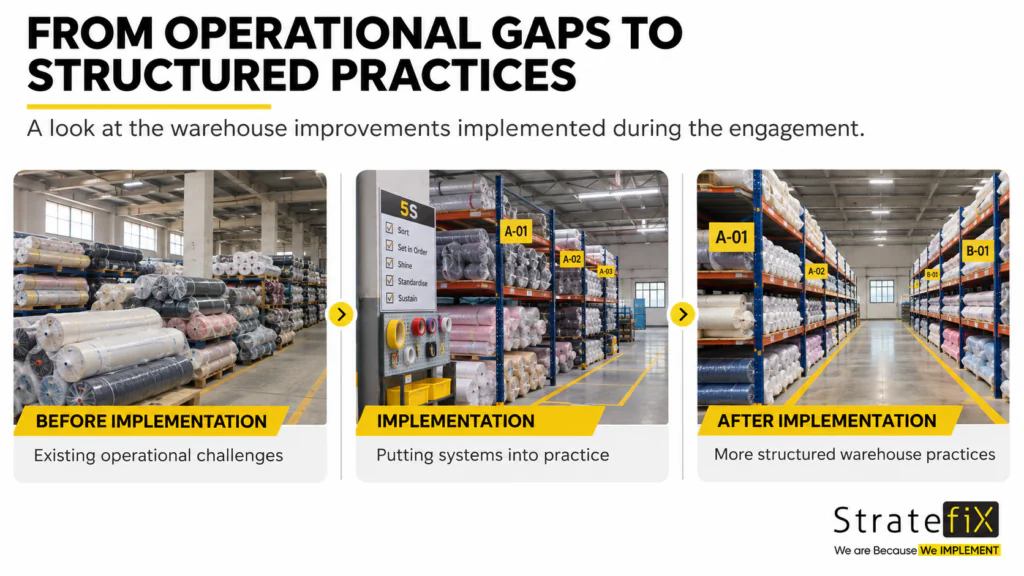
These measures were intended to make workplace organisation more consistent and less dependent on individual habits. They also provided visible standards against which warehouse conditions could be reviewed.
3. Bringing Consistency to Daily Operational Reporting
Inventory and warehouse activities are connected to several other operational functions. Without consistent reporting, it can be difficult to understand pending activities, review progress or follow up on gaps.
To address this, standard reporting formats were developed for key activities, including:
- Folding reports and Daily Sales Reports (DSR)
- Pending purchase orders and mill-pending status
- Job issue and receipt records
- Mill issue reports
- Warehouse inward records
Reporting responsibilities were clarified so employees had a better understanding of what information needed to be recorded and communicated.
The purpose was to establish a more consistent flow of operational information and provide the relevant teams with a structured basis for reviewing daily activities and following up on pending matters.
4. Establishing a Monitoring and Corrective-Action Process
Implementing a process is not enough if there is no mechanism to review whether it is being followed.
The engagement therefore included inventory audit formats, 5S check sheets, Gemba walk records, audit schedules and discrepancy tracking.
These tools provided a more defined approach to identifying gaps, recording observations, clarifying responsibilities and following up on corrective actions.
Instead of relying only on occasional checks, the team had formats and schedules to support recurring reviews of inventory and workplace standards.
5. Building Internal Ownership for Continued Implementation
For the implemented systems to remain useful, the internal team needed clarity on their responsibilities after the consulting team’s implementation activities.
Employee training and guidance were supported by the identification of zone leaders, defined daily reporting responsibilities and work instructions.
A sustainability plan and recurring audit requirements were also prepared and handed over. These provided the internal team with a reference for continuing inventory-code reviews, sample-based verification, 5S checks, reporting reviews and corrective-action follow-ups.
Measurable Improvements
The project records reported improvements across inventory accuracy, material search time and warehouse space utilisation.
Performance indicator | Before | Reported after implementation |
Inventory accuracy | Approx. 75% | Above 95% |
Material search time | Approx. 120 minutes | 20–30 minutes |
Warehouse space utilisation | Baseline | 5% improvement |
These results reflect improvements in three practical areas of warehouse operations.
Higher reported inventory accuracy indicates better alignment between physical stock and recorded inventory. Reduced material search time indicates that teams could locate materials with less search effort. Improved space utilisation reflects progress in organising the available warehouse space.
Alongside these improvements, approximately 5.59 lakh metres of inventory across 704 SKUs were counted, coded and entered into Frontline software.
Note: Performance figures are based on project records. Measurement methods and review periods may differ across indicators.
From Implementation to Sustained Operational Discipline
The engagement established a more structured approach to managing inventory, organising warehouse activities, recording daily operational information and reviewing process gaps.
However, the continued effectiveness of these systems depends on regular use. Inventory-code reviews, sample-based stock audits, weekly and monthly 5S checks, daily reporting discipline and corrective-action follow-ups remain important responsibilities for the internal team.
The handover included work instructions, audit formats, defined responsibilities and a sustainability plan to support these activities. Remaining reconciliation and warehouse improvement activities were also identified for continued follow-up.
Stronger Operational Control Through Consistent Execution
The project addressed connected operational challenges across inventory identification, stock verification, warehouse organisation and daily reporting.
By working alongside the internal team, Stratefix Consulting helped translate these requirements into practical processes, implemented controls and defined monitoring mechanisms.
The result was a stronger foundation for inventory visibility, more organised warehouse operations and greater consistency in day-to-day operational management.