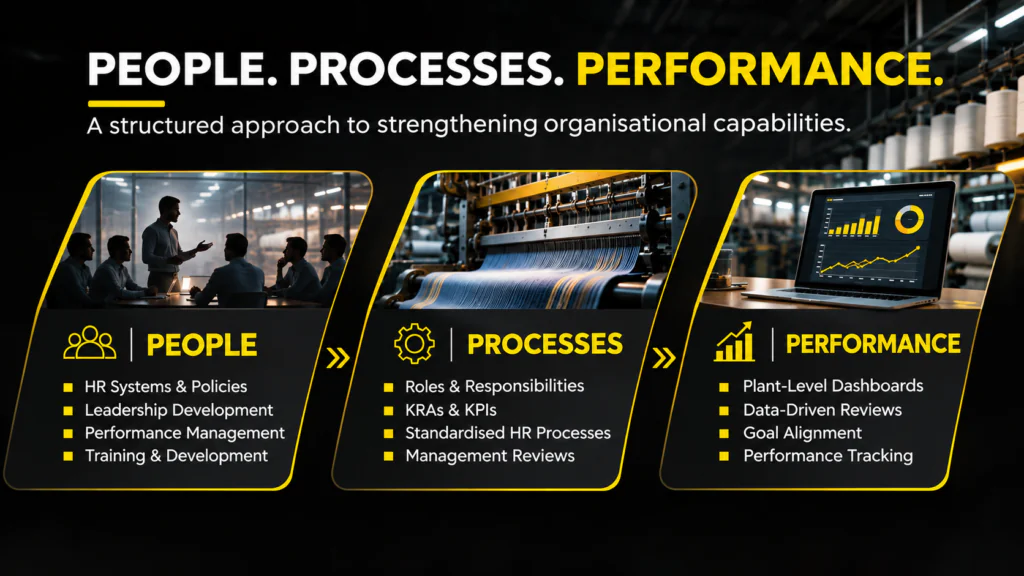
How an established textile manufacturing group strengthened its people, processes and management systems through a 30-month transformation journey with Execution-led consulting approach.

A Legacy Built Over Three Decades

In textile manufacturing, building a successful business takes more than production capacity. It requires technical expertise, consistent quality, skilled people and the ability to coordinate multiple processes.

Established in 1988, this textile manufacturing group has spent more than three decades building its presence in Surat, Gujarat. Over the years, it has developed into a multi-unit organisation with capabilities spanning several specialised textile processes.

Its manufacturing operations include: Embroidery, Knitting, TFO, Garment Manufacturing and Digital Printing.

These capabilities are supported by departments such as HR, MIS, Accounts, Sales, Design and Merchandising, and the Digital Division.

The organisation is led by eight directors, with individual manufacturing units managed by their respective plant heads and teams.

This combination of manufacturing expertise, multiple production units and supporting functions reflects the scale and operational diversity the business has developed over its journey.

As the organisation continued to evolve, its priorities naturally extended beyond manufacturing capabilities. Coordinating people, processes and performance across multiple units became increasingly important.

The Next Stage of Growth: Bringing People, Processes and Performance Together

Managing a multi-unit manufacturing business involves several interconnected responsibilities.

Each unit has its own workforce, supervisors, production requirements and operational priorities. Supporting departments must coordinate with manufacturing teams, while leadership needs a consistent view of performance across the organisation.

The company’s directors had played an active role in guiding these activities throughout its journey. Their experience and involvement remained important to the business.

As the organisation developed, there was an opportunity to complement this leadership experience with more formal systems that could support its evolving requirements.

The priorities included strengthening the HR function, bringing greater consistency to employee processes, defining responsibilities across different levels, and creating a more structured approach to performance and management reviews.

There was also an opportunity to develop employee capabilities and improve how information from different manufacturing units reached management.

The objective was not to change what had made the business successful. It was to build on that foundation by developing systems that could support its next phase of growth.

This became the starting point of a 30-month organisational transformation engagement with Stratefix Consulting in April 2024.

Understanding the Organisation Before Shaping Its Future

The first step was to understand how the business functioned across its manufacturing units and supporting departments.

Stratefix Consulting worked alongside the company’s directors and plant teams to understand existing practices, review responsibilities and identify opportunities to strengthen organisational processes.

The assessment covered:

  • Discussions with directors to understand existing management and HR practices.
  • Visits to manufacturing units and mapping of operational processes.
  • Review of unit-wise organisational structures and reporting relationships.
  • Assessment of employee documentation, attendance and HR processes.
  • Review of existing responsibilities, performance practices and training requirements.

This exercise helped establish a common understanding of the organisation’s requirements and areas for development.

It also highlighted an opportunity to move towards common systems for managing people, responsibilities and performance across the different units.

A phased roadmap was developed around five stages:

Diagnose → Design → Implement → Monitor → Sustain

The emphasis throughout the engagement was on practical implementation and adoption, with the company’s leadership, HR team and plant heads progressively taking ownership of the systems introduced.

The Transformation: Strengthening Six Areas of Organisational Development
1. Establishing a Dedicated HR Function

As the organisation developed, establishing a dedicated HR function became an important priority.

The focus was to create a more consistent employee-management framework across the business, supported by defined processes, documentation and internal ownership.

The work began with essential foundations such as employee records, joining documentation and attendance management. Biometric attendance processes were strengthened, a common employee master was developed, and standard joining formats were introduced.

The initiative expanded to include:

  • Leave and attendance policies.
  • Recruitment and employee referral processes.
  • Joining, onboarding and induction documentation.
  • Probation, confirmation and exit processes.
  • Employee records and HR documentation.
  • Code of Conduct and appraisal frameworks.
  • HR roles, responsibilities and process ownership.

An important development was the onboarding of a dedicated HR Manager, giving the organisation an internal function to manage recruitment, onboarding, policies, employee processes and performance-management follow-ups.

The focus progressively moved from creating HR frameworks to enabling the internal HR team to operate and improve them.

2. Defining Responsibilities Across the Organisation

In a multi-unit manufacturing setup, clarity of responsibility is essential.

Plant heads, supervisors and employees need to understand their roles, while leadership needs visibility into how responsibilities are distributed across departments and units.

The transformation included the development of:

  • Organisational structures and Job Descriptions.
  • KRAs and KPIs for plant heads and other organisational levels.
  • Responsibility mapping through RACI frameworks.
  • Director-level task sheets and KRA/KPI frameworks.
  • Performance Management System policies and review cycles.
  • Goal-setting and OKR discussions.

Task sheets were prepared for all eight directors, creating greater visibility into leadership responsibilities.

The work subsequently extended to plant heads and the second and third organisational layers, with responsibilities and performance expectations progressively documented and discussed.

By September 2026, KRA/KPI frameworks and targets had been validated across seven units, including Designer and Sales roles.

This created a more structured basis for understanding responsibilities, reviewing performance and strengthening accountability.

3. Building a Performance-Driven Organisation

Defining responsibilities is only the beginning. The next step is connecting them with measurable expectations and regular reviews.

The company began moving towards a more structured Performance Management System (PMS), with KRAs, KPIs, targets and review cycles introduced progressively.

The first performance cycle for plant heads was reviewed and refined before the approach was extended to the second organisational layer.

The initiative included:

  • Development of the PMS policy and review formats.
  • KRA/KPI target-setting across manufacturing units.
  • Performance review cycles for plant heads and supervisors.
  • Goal-setting discussions with leadership.
  • Personal Development Plans (PDPs).
  • Rating and assessment formats.
  • Nine-Grid assessment inputs and analysis.

By building these practices in stages, the organisation could develop a performance framework that connected individual responsibilities with the requirements of different units.

The objective was to make performance discussions more consistent and create a foundation for continuous improvement.

4. Developing Leadership and Employee Capabilities

A business’s long-term strength depends not only on its manufacturing infrastructure, but also on the capabilities of the people managing and operating it.

The engagement therefore included a structured focus on leadership development, employee learning and team alignment.

A training calendar was introduced for plant heads, with a target of two training sessions per plant head each month.

Leadership development initiatives began with the directors’ team through the Shubharambh Leadership Development Programme. The development journey subsequently expanded to include:

  • Leadership development for directors and plant heads.
  • Skill-matrix-based training planning.
  • Personal Development Plans.
  • Training and development across organisational levels.
  • Nine-Grid assessments.
  • Growth Circle sessions.
  • Team-alignment initiatives for supervisors and the third organisational layer.

The initiatives extended beyond senior management and plant heads, bringing employees at different organisational levels into the learning and alignment process.

This helped make employee development a more structured part of the organisation’s management approach.

5. Strengthening Management Visibility Through Data

For an organisation operating across multiple manufacturing units, having consistent information is important for effective management discussions.

The engagement progressively introduced:

  • Plant-head dashboards and reporting formats.
  • Weekly meetings with plant heads, in-charges and supervisors.
  • Monthly dashboard and management reviews.
  • Dashboard benchmarks.
  • Board-level review and action-plan mechanisms.
  • A Dashboard Standard Operating Procedure.

A significant development was the company’s first data-driven Board meeting supported by dashboards.

This represented an important step towards more structured management discussions, supported by information from different parts of the organisation.

The Dashboard SOP was subsequently prepared and explained to plant heads, helping make the review process more repeatable.

The objective was to help management move towards discussions supported by structured information, clearer action points and defined ownership.

6. Strengthening Internal Ownership and Governance

For organisational transformation to continue beyond a consulting engagement, the systems introduced must become part of the company’s regular management practices.

This requires more than documentation. It requires internal ownership, follow-up and continuous improvement.

During the engagement, Stratefix worked with the HR Manager, HR team and plant heads to strengthen the adoption of the processes introduced.

Key developments included:

  • Handover of PMS follow-up and HR responsibilities to the internal HR team.
  • Training the HR team on recruitment and onboarding.
  • Completion of the HR process audit and preparation of an action plan.
  • Development of the whole-company organisation structure.
  • Collection and analysis of Nine-Grid assessment inputs.
  • Preparation of team rating and peer-assessment formats.
  • Validation of KRA/KPI frameworks and targets across seven units.

By the later stages of the engagement, the company had an operational HR team, established employee processes, performance frameworks across key organisational levels and a more structured management review mechanism.

The focus had progressively shifted from introducing systems to strengthening their ownership within the organisation.

Key Developments Across the Organisation

The transformation brought together several important developments across HR, leadership, employee performance and management practices. Rather than introducing isolated processes, the focus was on building connected systems that could support the organisation across its manufacturing units.

A stronger HR foundation

  • A common Leave Policy implemented across departments.
  • Standardised employee documentation and HR processes introduced.
  • A dedicated HR Manager and internal HR function established.
  • A comprehensive HR process audit conducted, followed by an action plan.

Greater leadership and role clarity

  • Task sheets prepared for all eight directors.
  • Job Descriptions and KRA/KPI frameworks introduced across key roles.
  • Responsibility mapping through RACI frameworks.
  • KRA/KPI targets validated across seven manufacturing units.
  • Performance expectations extended to plant heads and subsequent organisational levels.

Structured employee and leadership development

  • A training calendar introduced for plant heads.
  • Shubharambh Leadership Development Programme conducted for the directors’ team.
  • Personal Development Plans and skill-matrix-based training initiatives introduced.
  • Growth Circle and team-alignment initiatives conducted.
  • Team-alignment training extended to the third organisational layer across units.

More data-driven management practices

  • First dashboard-supported Board meeting conducted.
  • Plant-level dashboards and reporting formats introduced.
  • Weekly operational meetings and monthly dashboard reviews established.
  • Dashboard benchmarks and a Standard Operating Procedure developed.
  • Structured action-plan and management review mechanisms introduced.

Together, these developments helped establish a stronger foundation for HR governance, leadership alignment, employee development and performance visibility across the business.

Measuring Organisational Progress

A transformation of this nature cannot be measured through the number of policies or formats created alone.

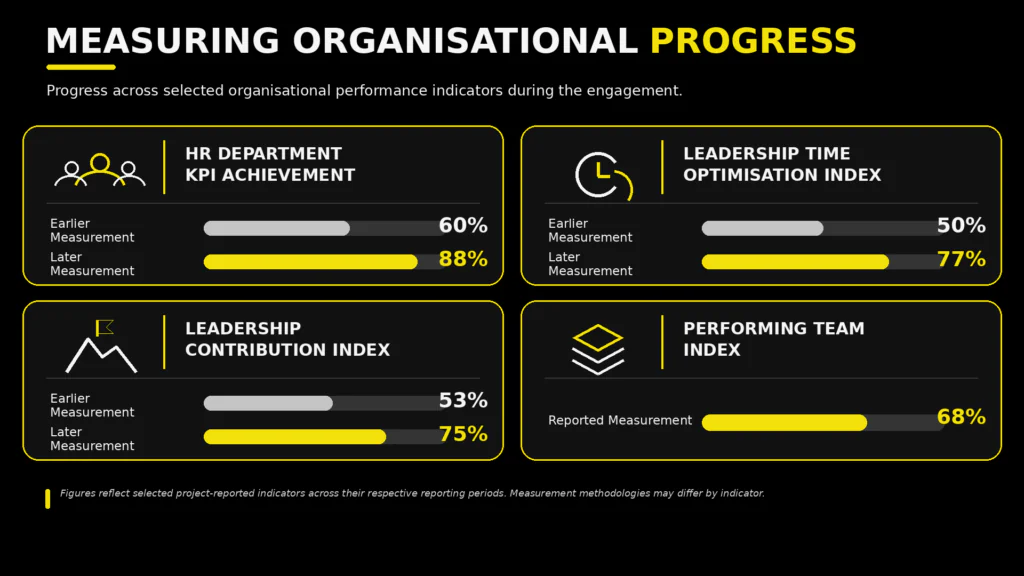
The project also tracked indicators related to HR performance, leadership, team development and organisational practices.

The following figures reflect progress recorded in the project’s reviews.
Project-Tracked Performance Indicators

Indicator

Earlier Measurement

Later Measurement

HR Department KPI Achievement

60%

88%

Leadership Time Optimisation Index

50%

77%

Leadership Contribution Index

53%

75%

Talent Development Index

63%

65%

Performing Team Index

—

68%

These are project-reported indicator measurements from the dates shown. The project report does not provide the underlying calculation methodology for every index. They should therefore be read as tracked project indicators, not independently verified measures of financial or operational performance.
What These Developments Mean for the Organisation

Beyond the individual indicators, the transformation established important organisational capabilities:

A dedicated HR function: An internal HR Manager and team to manage recruitment, onboarding, policies, employee processes and audits.

More structured employee management: Standardised documentation, attendance practices, employee records and onboarding processes.

Clearer responsibilities: Director-level task sheets, RACI frameworks, Job Descriptions and KRA/KPI structures across key roles.

A performance-management framework: Review cycles, development plans, training calendars and assessment formats.

A more structured management rhythm: Weekly meetings, monthly dashboards and data-supported Board discussions.

A foundation for operational analysis: Unit-wise ROI data and machine-wise manpower information were collected to support further analysis.

Together, these developments created a stronger organisational foundation for managing a business with multiple manufacturing units and diverse teams.

Connecting Organisational Development with Manufacturing Performance

For a textile manufacturing business, organisational effectiveness has implications beyond the HR department.

The way people are organised, responsibilities are distributed and performance is reviewed can influence how effectively manufacturing units operate.

Clearer manpower information can support workforce planning. Defined plant-head responsibilities can strengthen unit-level ownership. Regular dashboards can help management identify areas requiring attention.

During the later stages of the engagement, the work also began moving towards manpower optimisation and machine-efficiency analysis.

Machine-wise manpower data was collected, comparing current and standard manpower requirements. Unit-wise ROI data was also collected to support further analysis.

These activities created a starting point for examining how organisational resources connect with manufacturing performance.

The project report does not establish a verified before-and-after increase in revenue or profitability. Accordingly, the financial impact of these initiatives should not be overstated. The documented progress is in the organisational systems, management practices and project-tracked indicators developed during the engagement.

Building on the Foundation

By September 2026, the company had made progress in developing its organisational systems.

An internal HR function was operational, employee processes had become more structured, performance frameworks were in place and management reviews were increasingly supported by dashboards.

As with any long-term transformation, certain priorities continued into the next stage:

  • Approval and implementation of the company-wide organisation structure.
  • Maintaining consistency in monthly dashboard meetings.
  • Further strengthening HR analytics and reporting.
  • Advancing manpower optimisation and machine-efficiency analysis.
  • Developing unit-wise ROI visibility.
  • Continuing the development of plant heads and internal teams.

The HR-ERP module had also been discussed, although its implementation remained on hold.

These priorities represent the natural progression from establishing systems to improving their consistency, adoption and business relevance.

A Stronger Organisation for the Journey Ahead

A manufacturing business built over decades carries valuable experience, operational knowledge and leadership capabilities.

As it evolves, the opportunity lies in bringing these strengths together through systems that support its people, clarify responsibilities and create greater visibility across the organisation.

Over 30 months, this textile manufacturing group progressed from strengthening its HR foundation to developing performance frameworks, leadership practices, employee development initiatives and structured management reviews.

The journey required active involvement from the company’s directors, HR team and plant heads, alongside a sustained focus on implementation.

Through Execution-led consulting approach, Stratefix Consulting worked alongside the organisation to understand its requirements, design practical frameworks, support on-ground implementation, monitor progress and strengthen internal ownership.

The outcome was not simply a set of policies, dashboards or performance formats. It was a more structured organisational foundation built around the people and processes that support the company’s manufacturing capabilities.

Because building a strong manufacturing business is one achievement. Building an organisation equipped to take it forward is the next.

Stratefix Consulting
We are Because We IMPLEMENT.