HR Remains One of the Most Misunderstood Functions in MSMEs
Human Resource Management plays a critical role in building stable, productive, and scalable organizations. However, in Indian MSMEs, HR is still largely perceived as an administrative or support function rather than a strategic one.
To understand how MSME entrepreneurs perceive HR and how HR functions are actually implemented at the ground level, Stratefix Consulting conducted a survey among over 1,000 MSME entrepreneurs across India.
Key Survey Finding
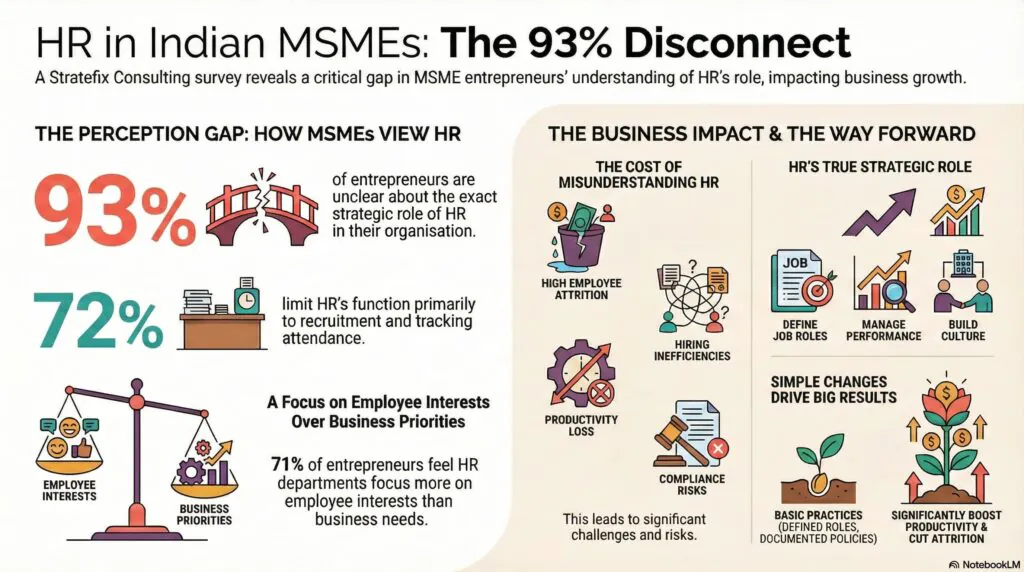
93% of MSME entrepreneurs stated that they are unclear about the exact role of HR in their organization.
This lack of clarity has a direct impact on employee retention, productivity, compliance, leadership bandwidth, and long-term business growth.
Stratefix Consulting Survey Overview on HR in MSMEs
The survey was designed to capture real-world HR practices followed by MSMEs, rather than theoretical HR models.
Survey Objective
The objective was to understand:
- How MSME entrepreneurs define the HR function
- What responsibilities are assigned to HR
- Which HR processes are implemented in practice
- Where gaps exist between business needs and HR execution
Survey Coverage
- Respondents: 1,000+ MSME founders, directors, and senior managers
- Industries Covered: Manufacturing, engineering, textiles, services, trading, and professional businesses
- Organization Size: 20 to 500 employees
Key Survey Findings on the Role of HR in MSMEs
The survey results indicate that HR in MSMEs is largely limited to transactional activities and lacks strategic involvement.
93% Entrepreneurs Lack Clarity on HR’s Strategic Role
Most respondents were unable to clearly explain how HR contributes to productivity improvement, cost control, or business scalability.
72% MSMEs Limit HR to Recruitment and Attendance
HR is largely seen as a hiring and attendance-tracking function, with minimal involvement in performance management or capability development.
64% MSMEs Do Not Have Defined Job Descriptions or KRAs
A majority of businesses operate without documented roles and responsibilities, leading to role overlap, confusion, and accountability issues.
58% Lack a Structured Performance Evaluation System
Performance reviews, where conducted, are mostly informal and subjective, making it difficult to link performance to business outcomes.
73% MSMEs Do Not Follow Formal Training Programs
Training is mostly reactive and on-the-job, resulting in skill gaps, repeated mistakes, and inconsistent productivity.
These findings clearly show that HR exists in most MSMEs but lacks structure and strategic direction.
Additional Insights from the Stratefix MSME HR Survey
Beyond operational gaps, the survey also captured how MSME entrepreneurs perceive the priority, intent, and business relevance of HR.
- 67% of MSME entrepreneurs believe recruitment is the primary responsibility of HR
- 23% consider staff training as HR’s main role
- Only 10% believe HR should focus on improving employee efficiency and performance
This clearly indicates that HR is largely viewed as a support function rather than a performance or growth driver.
The perception gap becomes more evident in how HR’s contribution to business is viewed:
- 71% of entrepreneurs feel HR departments focus more on employee interests than business priorities
- Only 23% believe that the HR function is actually fulfilling its intended purpose
- Just 18% of respondents feel HR plays a major role in business growth or decline
- 58% believe HR does not need access to financial information such as turnover or profitability to perform effectively
These insights reinforce the core survey finding – HR is present in MSMEs, but its strategic relevance is neither understood nor leveraged.
Why HR Is Often Misunderstood in Indian MSMEs
The confusion around HR is largely structural rather than intentional.
Founder-Driven and Informal Growth
Most MSMEs start small, with promoters directly managing hiring, performance, and discipline. As the organization grows, these informal practices continue without formal systems.
HR Viewed as an Administrative Function
HR is commonly associated with payroll, attendance, and compliance rather than productivity improvement, cost optimization, and people development.
Limited Awareness of HR’s Business Impact
Many entrepreneurs face attrition, inefficiencies, and team dependency but do not directly link these issues to weak HR systems.
Business Impact of Poor HR Understanding in MSMEs
The survey highlights several recurring business challenges resulting from unclear HR roles.
High Employee Attrition
Employees leave due to unclear expectations, lack of feedback, inconsistent management practices, and limited growth visibility.
Hiring Inefficiencies and Skill Mismatch
Unstructured hiring leads to frequent replacement, higher recruitment costs, and productivity loss.
Productivity Loss and Owner Dependency
Without KRAs and KPIs, accountability remains unclear, increasing dependence on promoters for daily operations.
Compliance and Process Risks
Lack of documentation, unclear payroll practices, and absence of formal policies expose MSMEs to operational and legal risks.
Exact Role of HR in an MSME Organization
The survey clearly highlights the need to define HR’s role in practical, business-relevant terms.
HR in an MSME is responsible for:
- Recruitment and structured onboarding
- Defining job roles, KRAs, and KPIs
- Performance evaluation and feedback
- Training and skill development
- Payroll management and statutory compliance
- Policy formulation and culture building
The primary role of HR is to create clarity, consistency, and discipline in people management.
Top HR Challenges Faced by MSMEs in India
Based on survey responses and consulting experience, MSMEs commonly face:
- Lack of role clarity and accountability
- Skill gaps due to unstructured hiring
- Absence of documented HR processes
- Inconsistent onboarding and training
- Communication gaps between leadership and employees
These challenges directly restrict operational efficiency and scalability.
Practical Learnings from the MSME HR Survey
The survey indicates that MSMEs do not need complex HR systems to improve outcomes.
Even basic HR practices such as:
- clearly defined roles
- KPI-based performance tracking
- structured onboarding
- documented policies
can significantly reduce attrition, improve productivity, and free up leadership bandwidth.
Conclusion - What the Stratefix MSME HR Survey Reveals
The survey conducted by Stratefix Consulting clearly shows that HR remains one of the most misunderstood functions in MSMEs.
With 93% of entrepreneurs unclear about HR’s role, and only 18% linking HR directly to business growth, there is a strong need for awareness, structure, and practical HR frameworks tailored to MSME realities.
Businesses that invest early in defining HR roles and processes are better positioned to build stable teams, improve efficiency, and scale sustainably.